Marketing automation workflows that actually convert in B2B
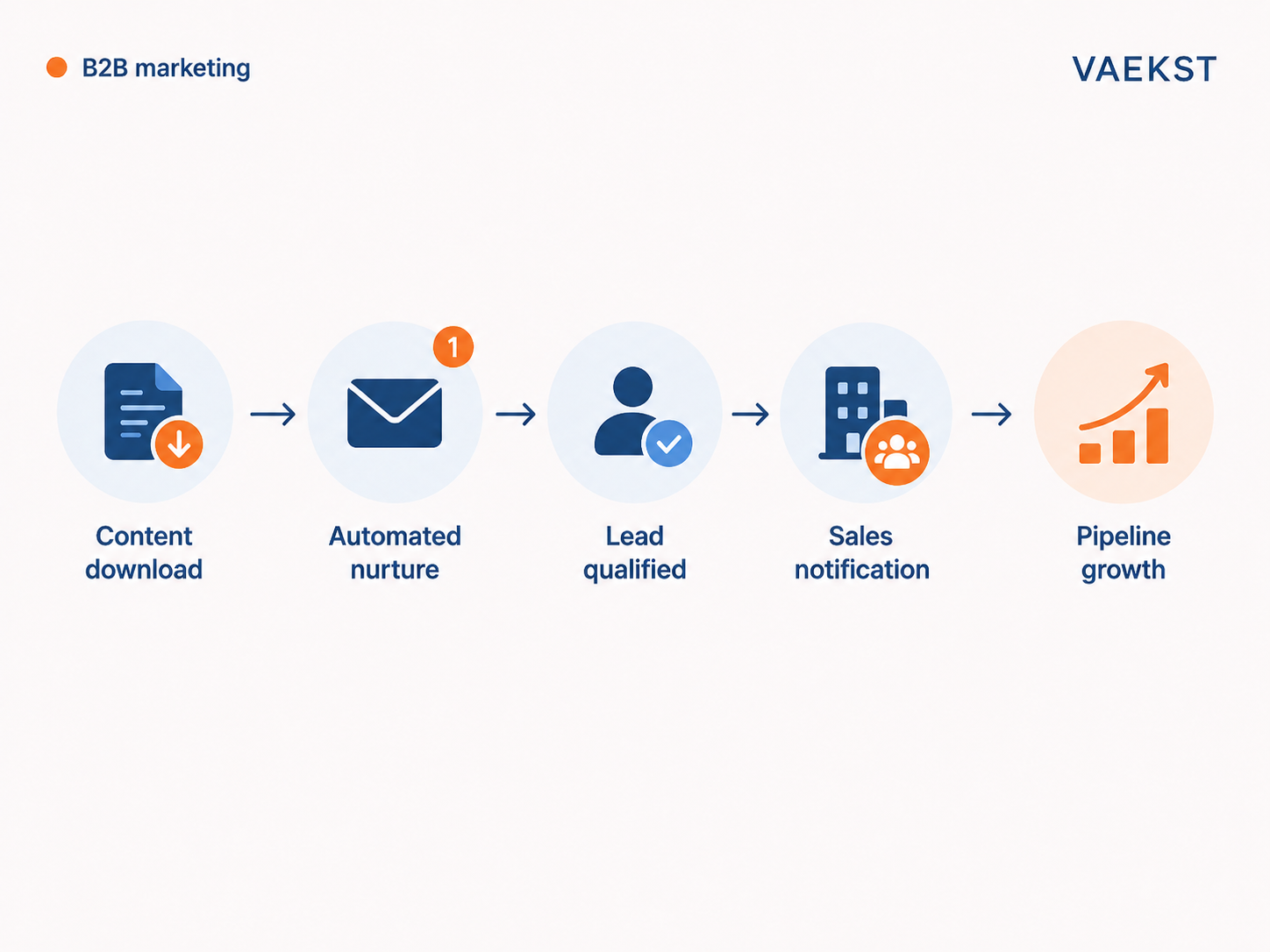
B2B marketing teams often invest in automation to improve efficiency, but the commercial value depends on whether those workflows help the right buyers progress with greater clarity, urgency and confidence.
This is where many B2B marketing automation workflows underperform. They are designed around internal logic rather than buyer behaviour: a contact downloads a guide, enters a nurture flow, receives a series of generic emails and gets passed to sales once a lead score reaches an arbitrary threshold.
HubSpot may show plenty of activity, while the connection to qualified pipeline remains unclear. This article explains how to build B2B marketing automation workflows that improve lead quality, identify account-level intent and support a more effective sales handover. It also covers where automation should sit inside a broader B2B Marketing setup, how HubSpot can support better commercial execution and when Account-Based Marketing should shape your workflow strategy.
Why b2b marketing automation workflows often underperform
The most common problem is that workflows are designed around content consumption rather than buying progression. A prospect reading three blog posts may be interested, but that does not mean they are ready for a sales conversation. Another prospect may only visit one pricing, integration or case page, but show far greater commercial intent. When workflows treat all engagement as equal, sales teams receive leads with unclear context. Marketing reports activity, sales questions quality and the buyer receives follow-up that does not match their actual stage in the journey.
This creates several practical issues: sales receives leads before or after the right moment, nurture content repeats information the buyer already understands, and high-intent accounts get lost within broad engagement data. More effective workflows begin with a commercial question: which buyer behaviours indicate genuine movement towards a decision?
Start with buyer stage, not automation logic
A workflow should reflect how buyers move from awareness to internal evaluation. That means the structure should follow the buying journey, not the automation platform. In B2B, this journey is rarely linear. Buyers move between problem exploration, solution comparison, internal alignment and risk evaluation. They may return to early-stage content while already discussing vendors internally. They may also engage heavily without having budget, authority or urgency. A useful workflow model separates intent into three levels.
Early interest: The buyer is exploring a topic, challenge or trend. They may read educational content, attend a webinar or download a broad guide. The goal here is not immediate sales conversion. The goal is to understand their area of interest and keep the communication relevant.
Active evaluation: The buyer engages with comparison content, case studies, service pages, demo pages or implementation material. This suggests a more specific need and should trigger sharper segmentation, more practical content and potential sales visibility.
Commercial intent: The buyer takes actions that indicate possible buying motion, such as repeated visits from the same account, engagement from several stakeholders, direct contact requests or interaction with bottom-funnel assets. At this stage, automation should help sales act quickly with the right context.
Build workflows around account behaviour
For many B2B companies, individual lead scoring is too narrow. A single contact may not show enough activity to look valuable, while the account behind them may be highly engaged. This is relevant in complex sales, where buying committees often include commercial, technical, operational and financial stakeholders. One person may read thought leadership, another may review integrations and a third may look at case studies. A good workflow should capture these signals at account level.
For example, if three contacts from the same company engage with content around the same pain area within 30 days, that should trigger a different response than one isolated content download. Sales should see the account context, not just the latest form submission. This is where account-based marketing and marketing automation work well together. ABM defines the priority accounts and buying committees. Automation tracks engagement, segments behaviour and helps sales act when signals become commercially relevant.
Use lead scoring carefully
Lead scoring can be useful, but many scoring models become too complicated to trust. The problem is often false precision. A webinar attendance might be worth 20 points, a blog visit 5 points and an email click 3 points, but the total score does not necessarily tell sales whether a buyer has a real problem, a relevant role or a reason to act now.
A better scoring model should combine fit and intent. Fit should include company size, industry, geography, role and ICP relevance. Intent should include page visits, form submissions, repeat engagement, bottom-funnel content and account-level activity. A good-fit lead with moderate intent may be worth nurturing. A low-fit lead with high activity may not be worth sales time. A high-fit account with several engaged stakeholders should be visible quickly.
Create nurture workflows that answer real buying concerns
Many nurture sequences are too educational for too long. They explain the problem repeatedly without helping the buyer move towards a decision. In B2B, the buyer often needs enablement more than awareness. They need to understand the business case, compare options, involve colleagues and reduce perceived risk. That means nurture workflows should answer practical buying questions such as:
- What happens if the company does nothing?
- Which internal teams need to be involved?
- What does implementation require?
- How have similar companies approached this?
This is where content should become more practical as intent increases. Early-stage workflows can share market insights and problem framing. Mid-stage workflows should introduce use cases, selection criteria and stakeholder-specific value. Later-stage workflows should support decision confidence with cases, ROI logic, implementation guidance and sales handover. A high-performing B2B Marketing setup connects these content layers to the buying journey, so automation does not just distribute content. It helps buyers progress.
Make sales handover part of the workflow design
Marketing automation should not stop when a lead becomes sales qualified. The handover is often where conversion breaks. Sales needs to know why the lead matters, what triggered the handover and how to continue the conversation without sounding disconnected from the buyer’s journey. A useful handover should include:
1. the buyer’s main engagement theme
2. the most important pages or assets viewed
3. account-level activity, role and ICP fit
4. a suggested conversation angle.
For example, a lead who has engaged with implementation content should not receive the same sales message as someone who downloaded a broad industry report. The first conversation can focus on practical adoption, internal readiness and potential barriers. The second may need more problem exploration before any commercial discussion. In HubSpot, this requires clean lifecycle stages, clear MQL and SQL definitions, relevant properties, task creation and sales notifications that give enough context to act.
Avoid over-automation in high-value B2B sales
Automation should support human relevance, not replace it. For high-value deals, too much automation can make the buying experience feel generic. A senior decision-maker who has shown clear buying intent should not be pushed through five more nurture emails before anyone reaches out.
Workflows should include clear exit criteria. When a lead reaches a certain level of intent, enters an opportunity, books a meeting or receives direct sales outreach, the automation should adapt. Otherwise, buyers receive irrelevant communication while already speaking with sales. This damages trust and creates internal confusion. A practical rule is to let automation handle structure, timing and context, while sales owns the moments where personal relevance matters most.
The b2b marketing automation workflows worth building first
For most B2B companies, it is better to build a few workflows properly than maintain a large collection of disconnected sequences. Start with these five.
1. Content engagement workflow: Segment leads based on the topics they engage with, then tailor future content around their pain area.
2. High-intent page workflow: Notify sales when relevant ICP leads visit bottom-funnel pages such as case studies, demo pages, implementation pages or service pages.
3. Account engagement workflow: Trigger alerts when several contacts from the same target account engage within a defined period.
4. Re-engagement workflow: Revive dormant leads with content based on previous interest, rather than sending generic “checking in” emails.
5. Sales handover workflow: Create tasks, update lifecycle stages and provide sales with context when a lead becomes qualified.
These workflows cover the most important commercial transitions: from interest to intent, from individual lead to account signal and from marketing engagement to sales action.
What to measure beyond email performance
Open rates and click rates can be useful for optimisation, but they rarely prove commercial value on their own. Better metrics include MQL-to-SQL conversion, SQL-to-opportunity conversion, pipeline influenced by workflows, meeting booking rate, sales acceptance rate, time from first engagement to sales handover and opportunity conversion by source.
These metrics show whether workflows are improving buyer progression or simply increasing activity. They also create better alignment between marketing and sales. Marketing can see which workflows produce commercially relevant leads. Sales can see which behaviours indicate real buying intent, and leadership can see whether automation contributes to pipeline quality.
Turning automation into a commercial system
B2B marketing automation workflows convert when they are built around buyer behaviour, account signals and sales relevance. The workflow should help buyers move through uncertainty, help sales act at the right time and help leadership understand which activities contribute to pipeline. That requires more than technical setup. It requires clear segmentation, relevant content, clean CRM data and alignment between marketing and sales.
VAEKST helps B2B companies build marketing automation and HubSpot setups that connect campaign activity to commercial outcomes. Explore how we support B2B Marketing, Account-Based Marketing and CRM optimisation for companies that want better pipeline quality from their growth engine.
Let's have a chat about your GTM
Have a virtual cup of coffee with one of our sales experts to explore collaboration opportunities.