How to Personalize B2B Cold Outreach Without Wasting Hours
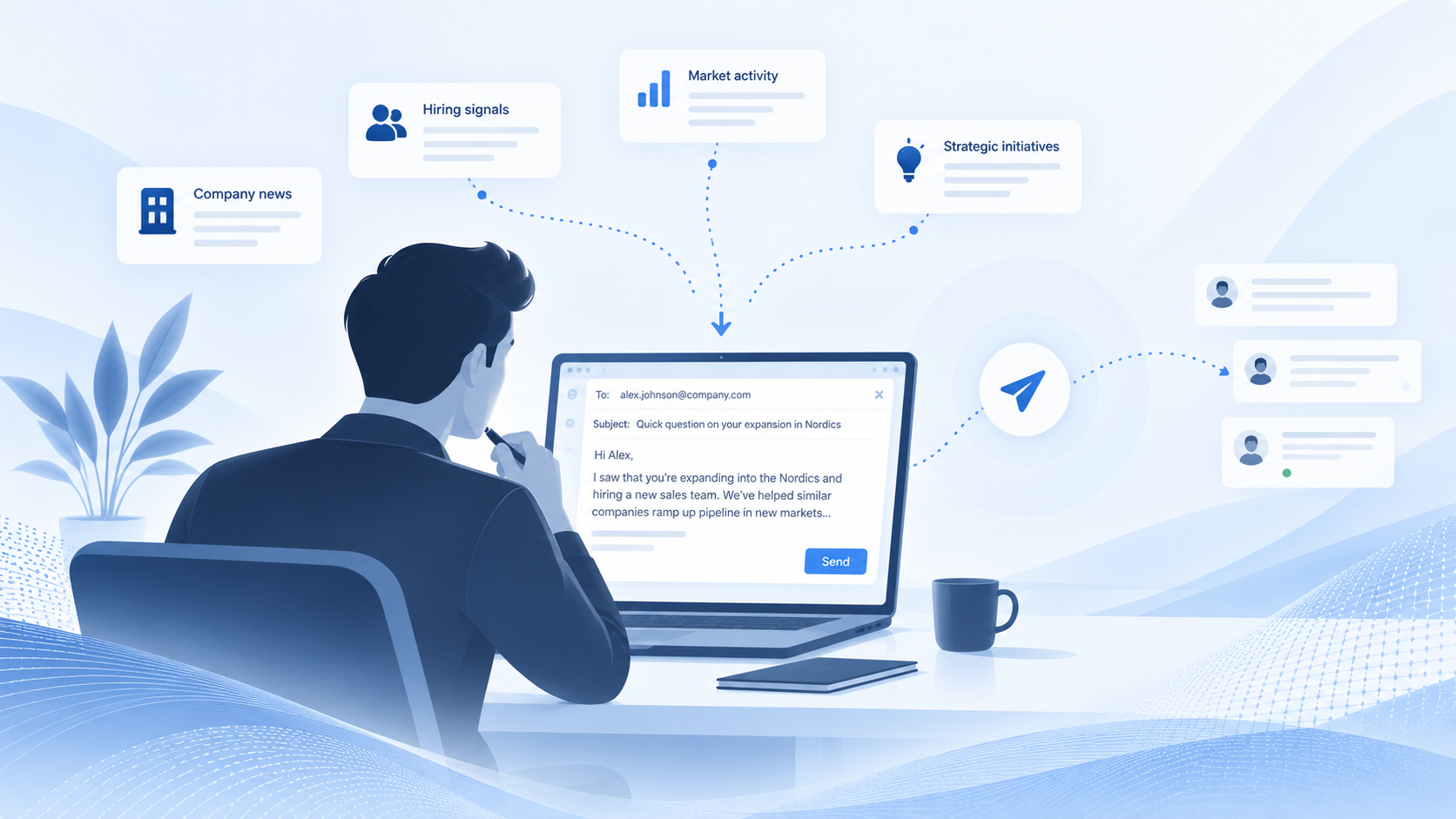
Personalisation improves outbound when it gives the prospect a credible reason to believe the message was written with their commercial reality in mind. The challenge appears when sales teams translate that principle into ten minutes of research for every email. At scale, those minutes add up quickly. A team contacting hundreds of accounts cannot treat every prospect like a strategic account while maintaining the activity levels required to create pipeline.
Effective B2B cold outreach personalization therefore depends on being selective. The sales rep needs enough context to make the outreach relevant, while the commercial system around them needs to keep research and preparation efficient. This article explains how to decide where personalisation deserves time, turn buyer signals into relevant messaging, build reusable workflows, use technology without producing generic copy, and measure the commercial return on the extra effort.
Personalisation should earn the time you spend on it
The value of personalisation depends on the value of the opportunity and the information available. A large strategic account with several relevant stakeholders deserves more preparation than a lower-priority prospect in a broader outbound segment. Applying the same research depth to every account usually creates an inefficient sales process. Before deciding how much effort to invest, consider factors such as:
- Expected account value and commercial potential
- Strategic relevance within your target market
- Availability of meaningful buying signals
- Number of stakeholders involved in the decision
- Probability that additional context will materially improve the conversation
This is particularly important in structured Outbound Sales, where output needs to remain high enough to generate sufficient pipeline coverage. Personalisation should increase your probability of creating a qualified conversation. When additional research contributes little to that probability, the time is better spent elsewhere.
Start with commercial relevance before writing the message
A common mistake is researching a prospect without knowing what information would actually make the outreach better. Scrolling through company websites and LinkedIn profiles can produce plenty of facts, but many of them have little commercial value. Instead, look for signals that change your understanding of the account, such as:
- Market activity: expansion into a new country or segment
- Commercial investment: increased recruitment or changes in senior leadership
- Strategic change: a new initiative or shift in the technology stack
The purpose is to identify information that supports a credible hypothesis about the prospect's priorities. If a B2B SaaS company is recruiting enterprise salespeople in Sweden, for example, the useful observation is not simply that the company is hiring. The commercial implication may be that it is building local sales capacity and needs to create sufficient pipeline for those new hires. That gives the salesperson a commercially relevant reason to start the conversation.
Turn signals into messages with a simple framework
A useful way to structure outbound personalisation is:
Signal → commercial implication → relevant message
The signal gives you the evidence needed to form a credible hypothesis about the account. From there, you can connect what is happening in the business to a likely priority and use that as the basis for your outreach. Consider a consultancy opening an office in Norway. The expansion may indicate a greater need to build awareness and create pipeline beyond the firm's existing referral network. Instead of simply congratulating the prospect on the new office, the outreach can address the commercial challenge that comes with entering a new market.
Another example could be an industrial company recruiting a new commercial director. That change may indicate renewed attention on sales performance, market development or commercial processes. Your message should focus on the business issue you can credibly help with rather than the job announcement itself. This keeps personalisation focused on the prospect's commercial context and gives the outreach a clearer reason to exist.
Build reusable components around the personalised insight
Writing every email from a blank page creates unnecessary work. A more efficient approach is to standardise the parts of the message that do not require individual research and reserve manual effort for the section where relevance matters. An outbound message can be built around four components:
- A concise opening that establishes context
- The account-specific signal or observation
- A commercial hypothesis connected to your proposition
- A low-friction reason to continue the conversation
Your positioning, proof points and core commercial argument can often remain consistent across a segment. The variable element is the account context that makes the message timely. This also makes testing easier. When the underlying structure remains consistent, sales teams can analyse whether specific signals, hooks and hypotheses lead to higher conversion rather than changing the entire message for every prospect.
Automate information gathering while keeping human judgement
Technology can remove a considerable amount of research work from outbound. Sales teams can automatically collect information on companies, contacts, recruitment activity, CRM history and other relevant account data. The rep can then focus on deciding which information matters commercially. That distinction matters because automated personalisation often becomes generic when the system is asked to make the judgement as well as collect the information.
Tools such as Pitchbound support a more scalable outbound workflow by helping commercial teams structure prospecting and outreach. A well-configured HubSpot setup can provide the CRM layer around that process, ensuring account information, activities and outcomes remain connected. The sales rep should still determine whether the selected signal creates a credible reason for the prospect to engage. Automation makes that decision faster by reducing the amount of manual preparation around it.
Match the level of personalisation to the account tier
Account prioritisation provides a practical way to control how much time sales teams spend on research. For example:
- Tier 1: Strategic accounts receive individual research and account-specific messaging.
- Tier 2: Priority accounts receive personalisation based on defined triggers and shared commercial patterns.
- Tier 3: Broader ICP accounts receive segment-level messaging with limited manual research.
The exact model depends on deal size, market maturity and sales capacity. The principle is to allocate preparation time according to commercial importance. This is particularly relevant in Account-Based Marketing environments, where several stakeholders within the same company may require different messaging. Research performed at account level can be reused across contacts, reducing duplication while keeping the outreach relevant.
Use personalisation across the outbound sequence
Personalisation does not need to sit exclusively in the first email. Once a salesperson has found a relevant account insight, the same context can inform several interactions across the sequence. A phone conversation can explore the commercial hypothesis in greater depth, while LinkedIn activity can create familiarity before or between direct outreach attempts.
LinkedIn and social selling can be particularly useful when decision-makers need repeated exposure before they are ready to engage. Paid LinkedIn activity can also support outbound by increasing familiarity within selected accounts before sales activation. This gives sales teams more value from the research already completed. One useful insight can support multiple interactions rather than disappearing after a single email.
Measure the return on personalisation
Reply rates alone provide an incomplete picture of whether additional personalisation is worthwhile. A highly personalised campaign could generate more responses while consuming so much sales capacity that overall pipeline creation declines. Commercial teams therefore need to measure both conversion and efficiency. Useful metrics include:
- Positive response rate by personalisation level
- Meeting-to-SQL conversion
- Opportunity creation by account tier
- Average research time per prospect
- Qualified pipeline created per hour of outbound activity
These metrics help identify where additional research changes commercial outcomes. You may find that deeper personalisation creates a meaningful improvement among high-value accounts but produces limited gains across a broader segment. That insight should shape how the team allocates its time.
Make personalisation part of the outbound system
B2B cold outreach personalization becomes scalable when it is built into the commercial process rather than left to each salesperson to solve individually. A practical outbound system should make it clear:
- Which accounts justify additional research
- Which buying signals are worth acting on
- Which messaging structures can be reused across similar accounts
- How much preparation is producing better SQL and pipeline outcomes
This allows sales teams to make outreach relevant without letting research reduce the activity levels needed for predictable pipeline creation.
Explore how VAEKST approaches Outbound Sales or see how Pitchbound supports structured outbound execution.
Let's have a chat about your GTM
Have a virtual cup of coffee with one of our sales experts to explore collaboration opportunities.