How to improve outbound sales in consulting
Consulting firms rarely lack credibility. Many have recognised experts, strong client relationships and a clear point of view in the market. The commercial challenge starts when new pipeline depends too heavily on referrals and the personal networks of senior partners.
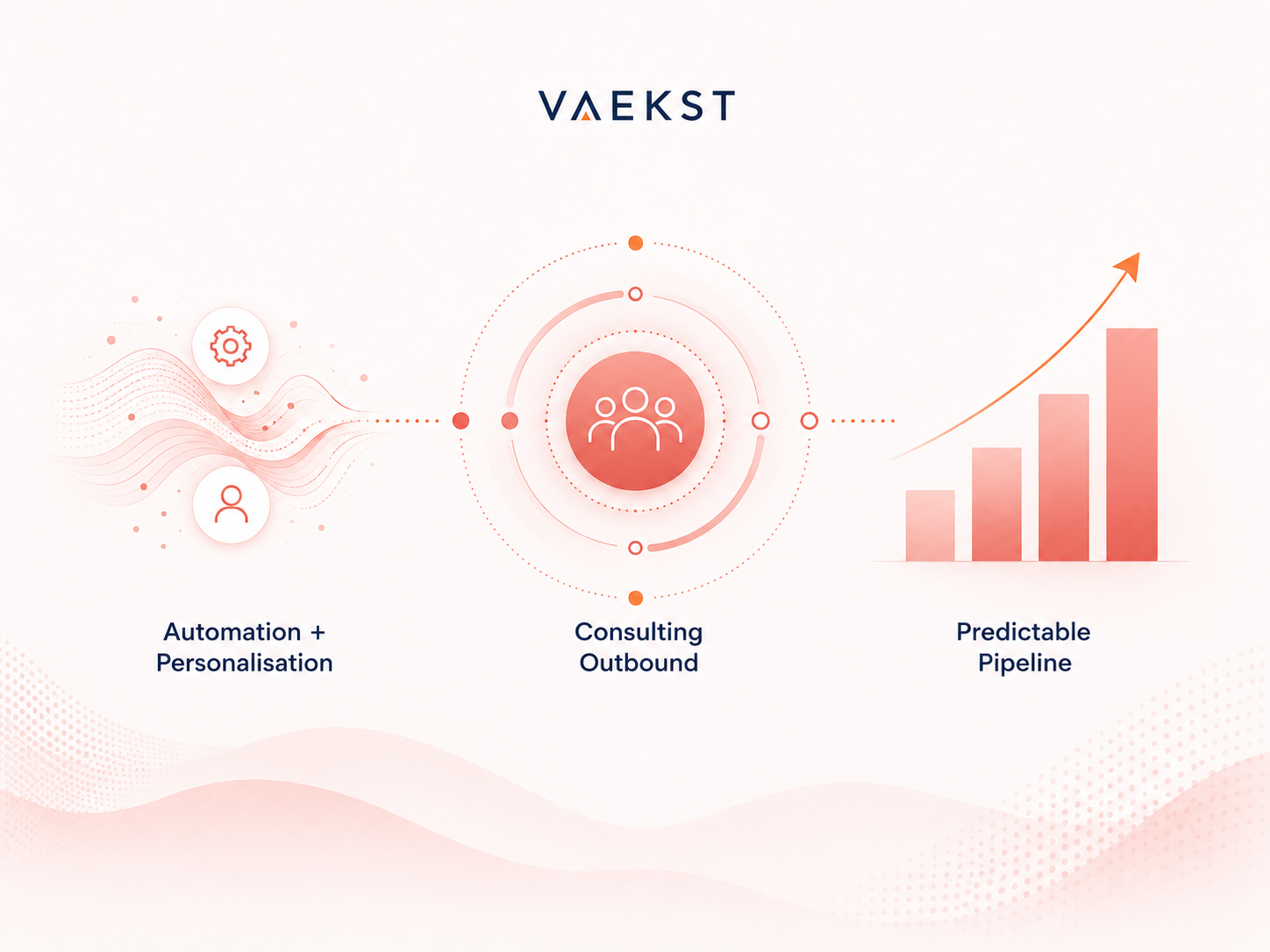
This is where outbound sales in the consulting industry needs to evolve. Many firms still associate outbound with high-volume calling and generic sequences, but that approach breaks down quickly when consulting buyers are evaluating complex expertise and internal risk. To work in that environment, outbound needs more than activity volume. It needs automation to create consistency and personalisation to make each conversation commercially relevant. In this article, we look at how consulting firms can combine both to build more predictable pipeline without weakening the trust their brand depends on.
Why consulting outbound needs a different model
Consulting is rarely sold as a simple product. Buyers are often considering strategic change, organisational risk or capability gaps. That makes the sales process more sensitive than in many transactional B2B categories. A CFO considering a cost transformation project or a CIO exploring a systems implementation will not respond well to generic claims. They need to feel that the outreach comes from someone who understands their context and the commercial implications of the problem.
Partner-led outreach can be highly relevant, but it rarely scales beyond the capacity of a few senior people. Automation creates rhythm and follow-up discipline, but credibility drops quickly when the message feels generic. A stronger model uses data and automation to structure the process, then applies personalisation where it has a clear impact on conversion.
The role of automation in modern consulting outbound
Automation is often misunderstood in professional services. Used poorly, it creates noise. Used well, it gives commercial teams more control over targeting and follow-up through stronger B2B sales infrastructure. For consulting firms, automation should improve account selection before outreach begins. Instead of relying on broad company lists, firms can build target segments around industry, company size, hiring signals, leadership changes or regulatory triggers.
It should also support workflow discipline. CRM tasks, follow-up reminders and pipeline stages reduce the risk that good conversations disappear because ownership is unclear. This matters in consulting environments where commercial responsibility often sits across partners, directors and delivery teams. Automation also makes performance easier to analyse. If outbound activity is not tracked consistently, it becomes difficult to understand which segments, messages and channels create qualified pipeline.
Where personalisation creates commercial value
Personalisation does not mean rewriting every message from scratch. In consulting outbound, it means proving relevance quickly. Strong personalisation usually connects to a business trigger, an industry pressure or a role-specific priority. A consulting firm targeting manufacturers might reference operational resilience. An IT consultancy approaching mid-market companies could anchor outreach around ERP complexity or system adoption.
This is where consulting firms often have an advantage. They already have insight, but that insight often stays inside reports, proposals and partner conversations. Modern outbound turns those perspectives into commercial conversation starters. The message should feel like it was written by someone who understands the buyer’s world. The message can be short, but the commercial angle has to be sharp enough to earn attention.
How automation and personalisation work together
Automation and personalisation should support different parts of the same outbound system. Automation creates structure, while personalisation gives the message a clear commercial reason to exist. For consulting firms, the balance typically works best across two levels:
- Segment-level personalisation: Define the core narrative for a market or company type. This could be a campaign aimed at private equity-backed SaaS companies, industrial manufacturers or public sector organisations.
- Account-level personalisation: Add specific company context, such as expansion plans, leadership changes, new regulation or public strategic priorities.
This gives the outbound process enough structure to scale without making every message feel mass-produced. The buyer should feel that the outreach is connected to their reality, not assembled from a generic sequence.
Sales enablement makes outbound repeatable
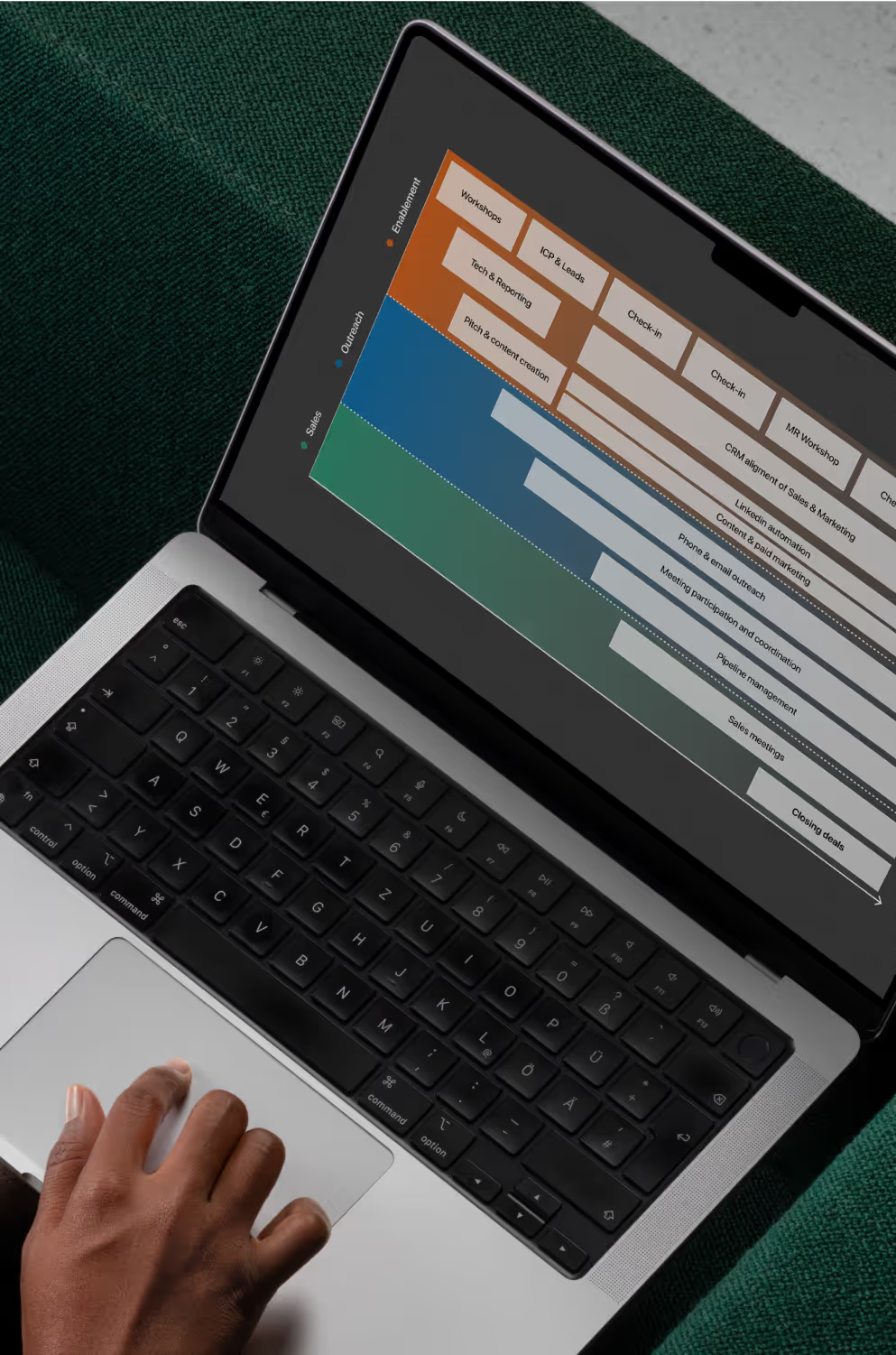
Many consulting firms underestimate the enablement layer behind outbound sales. Even a strong message will underperform if consultants and commercial teams lack the systems and process to execute consistently. Sales enablement should define how outbound turns into qualified opportunity creation. That includes ICP definitions, messaging pillars, outreach cadences, CRM fields, qualification frameworks and meeting structures.
This is especially important in consulting, where senior experts often enter the sales process after an initial meeting has been booked. If the handover is weak, the prospect experiences friction. If discovery is inconsistent, the firm loses insight that could have shaped the deal. Good enablement gives experts the context they need before the meeting and gives commercial teams the structure they need after it.
LinkedIn and social selling in consulting outbound
LinkedIn and social selling play a significant role in outbound sales in the consulting industry because trust often forms before the first conversation. Senior buyers often check the profile behind the outreach before deciding whether to respond. That makes personal positioning commercially relevant. Consultants and partners who are visible around specific themes create familiarity in the market, which lowers resistance when outreach begins.
LinkedIn Ads can also support outbound by warming target accounts before direct outreach. For example, a consulting firm can promote a market report or executive guide to a defined account list before the sales team begins direct engagement. The most effective model makes LinkedIn visibility support the same commercial narrative used in direct outreach. The buyer sees a consistent point of view across channels.
Building a modern outbound engine
Modernising outbound sales in the consulting industry requires more than adding automation software or rewriting email templates. It requires a commercial operating model that connects strategy, data, messaging and sales behaviour. The strongest consulting firms treat outbound as an extension of their expertise. They use automation to create structure, while personalisation ensures that each interaction feels commercially relevant.
VAEKST has helped B2B companies facilitate 300M DKK in closed sales deals and deliver more than 9,500 Sales Qualified Leads across the Nordics. For consulting firms, the opportunity is clear: build outbound in a way that respects the complexity of the sale while creating the predictability needed for growth.
Explore how VAEKST helps consulting firms strengthen Outbound Sales, Sales Enablement, LinkedIn activation and Pitchbound-supported sales execution.
Let's have a chat about your GTM
Have a virtual cup of coffee with one of our sales experts to explore collaboration opportunities.