How to Execute Your B2B Sales Process for Higher Win Rates

How to Execute Your B2B Sales Process for Higher Win Rates
Most B2B sales teams do not lose deals because the solution is weak.
They lose because meetings are forgettable, value is not clearly linked to the prospect’s objectives, and no concrete next step is secured.
If you want higher win rates in professional services and B2B, you need a sales process that:
- Makes the prospect like and trust you, your brand and your offering
- Connects your solution directly to their business objectives and timing
- Creates memorability and forces a clear next step
Your job is to turn the person in front of you into a champion and then into an internal ambassador who will carry your solution through their organisation. This playbook shows you how.
Step 1: Extraordinary Preparation
Well begun is half done. The easiest way to increase win rates is to show the prospect that you are professionally invested before you ever present a slide.
Deep dive on the prospect and account
Before the meeting, do a structured deep dive:
- Company: business model, corporate objectives, current strategy and key initiatives
- Prospect: role, responsibilities, likely KPIs and cultural setting
- Context: recent strategic moves, market shifts, hiring, product launches
Use this to build a hypothesis about:
- What they are trying to achieve
- Where they might be blocked
- How your offering could support their strategy
This immediately boosts likability and credibility, and sets you up to ask personalised questions rather than generic ones. You can use internal research support or tools like ChatGPT to speed this up, but the thinking must be yours.
Run a discovery call before key meetings
If the main meeting is more than 2 weeks away, run a short discovery call 2 to 5 days before:
- Reconfirm the meeting
- Ask what would make it valuable for them
- Mention 1 to 2 potential angles they could react to
- Assess if a physical meeting makes sense, and if you should bring in domain experts
Discovery calls serve three purposes:
- Increase show up rate
- Sharpen the agenda
- Either qualify or cancel meetings that should not happen
Aim for face time where it matters
Physical meetings tend to have higher conversion. For strategic opportunities, ask explicitly if a physical session would be useful. If they say yes, they already signal higher intent.
Step 2: Use Strategic Questioning To Find Real Opportunity
Great sales execution is essentially great questioning. Two complementary frameworks help you find real opportunities and create urgency.
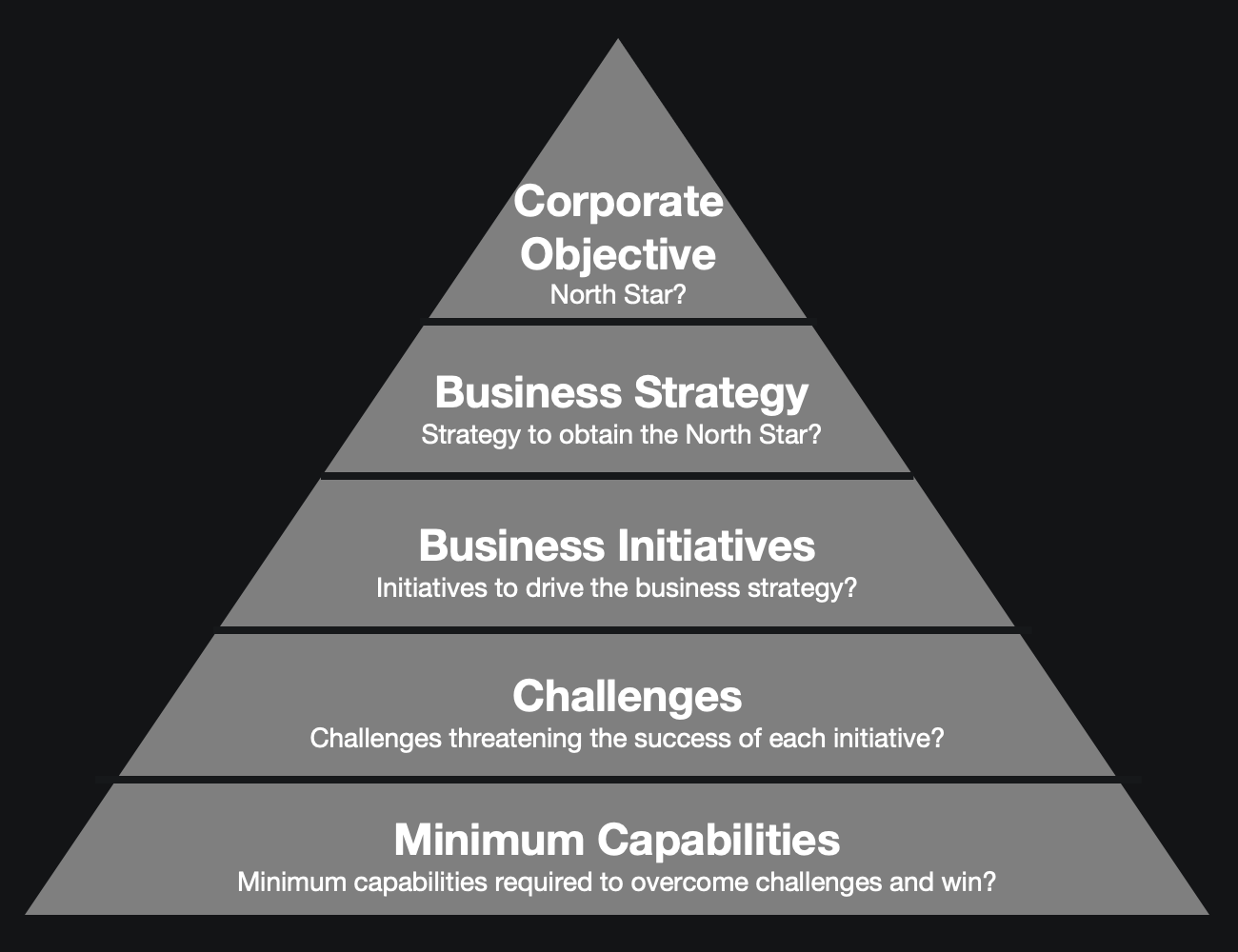
Tactic 1: The Strategic Pyramid
Use this sequence to connect your conversation to what really matters for the organisation:
- Corporate Objective
What is their North Star? Revenue, margin, market share, customer experience, expansion? - Business Strategy
How are they planning to reach it? New markets, new offerings, operational efficiency, acquisitions? - Business Initiatives
Which concrete initiatives are in play to execute that strategy? - Challenges
What threatens the success of these initiatives? Capacity, skills, systems, data, culture? - Minimum Capabilities
What capabilities must be in place to overcome those challenges?
Once you have these answers, you know exactly where collaboration makes sense and how to position your solution in their strategic context.
Tactic 2: Build the solution around current and future state (Tension)
Now you shift into designing a relevant and valuable solution:
- Current state and negative business outcomes
- What is happening today?
- What negative impact does it have on cost, revenue and risk?
- What is happening today?
- Future state and positive business outcomes
- What does “good” look like?
- What upside can they achieve in cost, revenue and risk?
- What does “good” look like?
- The tension
- What is the gap between current and desired state?
- Which metrics and capabilities will close that gap?
- What is the gap between current and desired state?
- Present the solution with clarity
- What will you do (features, core capabilities, methodology)
- Why you are better (unique selling points)
- Who says so (cases, references, social proof)
- How it creates 3 to 4 clear value drivers
- What will you do (features, core capabilities, methodology)
Step 3: Qualify Rigorously With MEDDICC
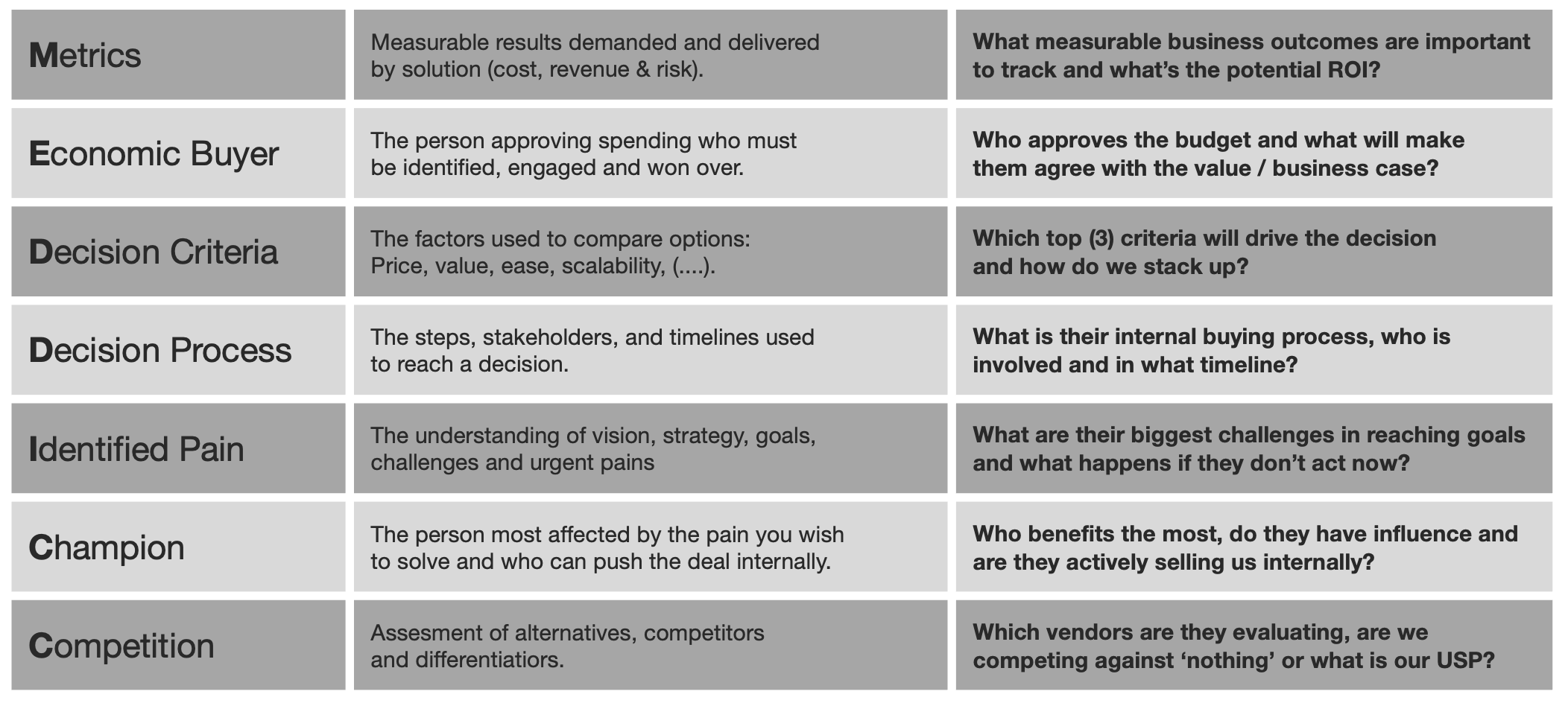
Complex B2B sales and professional services deals need serious qualification. MEDDICC gives you the structure.
Use MEDDICC as your running checklist:
- M – Metrics
Which measurable business outcomes matter to them and how will success be measured? - E – Economic Buyer
Who actually holds the budget and can say yes, and have you spoken with them? - D – Decision Criteria
What top 3 criteria will they use to compare vendors and how do you stack up? - D – Decision Process
What is their internal buying process, who is involved, what are the steps, and what is the timeline? - I – Identify Pain
What are their biggest challenges and what happens if they do nothing? - C – Champion
Who benefits most if you win, do they have influence, and are they actively selling you internally? - C – Competition
Which other options are they considering, including “do nothing”, and what truly differentiates you?
Integrate MEDDICC into:
- Discovery calls
- Opportunity notes in your CRM
- Deal reviews with your team
This prevents wasted time on weak deals, improves forecast accuracy and makes your next actions obvious.
Step 4: Exceptional Execution on Meetings
It is game time. Now, the way you run the meeting determines whether you create a champion or a polite “we will get back to you”.
Core principles
- Collaborate
Build the solution together so they feel ownership. - Dialogue, not monologue
The prospect should speak more than you. We remember conversations, not lectures. - Match their energy
Pay attention to their personality, pace and body language and adapt. Some want you to dominate, others value calmness.
Suggested meeting structure
You do not need to follow this rigidly, but it gives a strong default structure:
1. Intro
- Icebreaker: build a personal connection and lower defences
- Personal introductions from all sides
- Agenda: explain what you propose to cover
- Confirmation: ask if anything needs to be added or changed
Goal: Build a strong first impression and take control of the meeting while staying human.
2. Verify ICP and pain assumptions
- Confirm their business model and context
- Understand their role and local reality
- Ask about their key objectives and constraints
- Repeat back your understanding of their pains and outcomes
Goal: Align on the problem you are solving and decide which “storyline” to use in the rest of the meeting.
3. Co-create the solution
Never pitch before the need is acknowledged.
- Use the Strategic Pyramid and current/future state questions
- Show only the features, slides or angles that solve the agreed pains or support their KPIs
- Make it interactive with Power Questions for each key slide
Goal: Paint a vivid picture of their pain solved with your solution, so the price later feels justified by value.
4. Create a burning platform
Help them see why acting now matters:
- Link the issue to corporate objectives and strategy
- Clarify personal gains for the prospect if this succeeds
- Explore the risk and cost of delaying
Goal: Turn interest into urgency and start turning the prospect into a champion.
5. Build the solution together
Often this happens over several meetings.
- Define the What, How and Why of the solution together
- Map positive business outcomes for organisation and prospect
- Discuss who needs to be involved internally
Goal: Make them feel like a collaborator rather than a buyer.
6. Address alternatives and competition
Do not ignore competition, surface it.
- Ask which alternatives they are considering
- Ask which criteria they will weigh most
- Shape your USPs and cost benefit story around those criteria
Goal: Position clearly rather than vaguely. Make “do nothing” look unsafe.
7. Close with a specific next step
- Summarise what you have already agreed on
- Propose a concrete next step: business case workshop, involving more stakeholders, or drafting a proposal
- Clarify timing and responsibilities
Goal: Leave with a firm next action.
Step 5: Religious Consistency in Follow Up
A surprising amount of deals are lost simply because follow up is weak. You must invest more, not less, as the deal progresses.
Operational follow up
- Use a CRM like HubSpot to create structured deal pipelines
- Log notes after every meeting
- Create tasks with clear due dates and owners so no deal is left behind
Keep the same main salesperson across all meetings, even if you involve specialists. Consistency builds trust.
Collaborative follow up
Position follow up as a joint project:
- “Tomorrow we will build the business case together”
- “Next week we will bring in your finance lead and our solution architect”
This reinforces that you are on the same team.
Marketing follow up
Do not cut marketing spend when you get the first meeting. That is when you should double down on marketing.
Continue with:
- Targeted ads
- Personalised email flows
- Event invitations
- Thought leadership ads with match audiences
Brands that remain top of mind throughout the decision cycle are far more likely to win.
After the meeting
- Send a clear recap and proposal if agreed
- Set the expectation that you will follow up in a specific number of days
- Treat that follow up as a commitment, not a suggestion
Deadlines closer in time get prioritised. Use that psychology consciously.
Step 6: Measure and Optimise Your Sales Process
To truly optimise your B2B sales process, track a handful of critical metrics:
- Win rate percentage
- Time to close
- Stage conversion percentages
- Next step adherence, the percentage of opportunities that always have a next step booked
- MEDDICC completeness, for your top opportunities
Use these in pipeline reviews, coaching sessions and forecast meetings. The point is not to micromanage, it is to see exactly where deals stall so you can fix the process, not blame the people.
Let's talk B2B sales process optimisation
If you are ready to turn more sales meetings into signed clients, VAEKST helps professional services and B2B teams implement and execute B2B sales execution frameworks that fit your reality, your market and your brand.
Let us optimise your sales process and win rates.
Let's have a chat about your GTM
Have a virtual cup of coffee with one of our sales experts to explore collaboration opportunities.