Doing business in Finland: B2B sales for tech companies
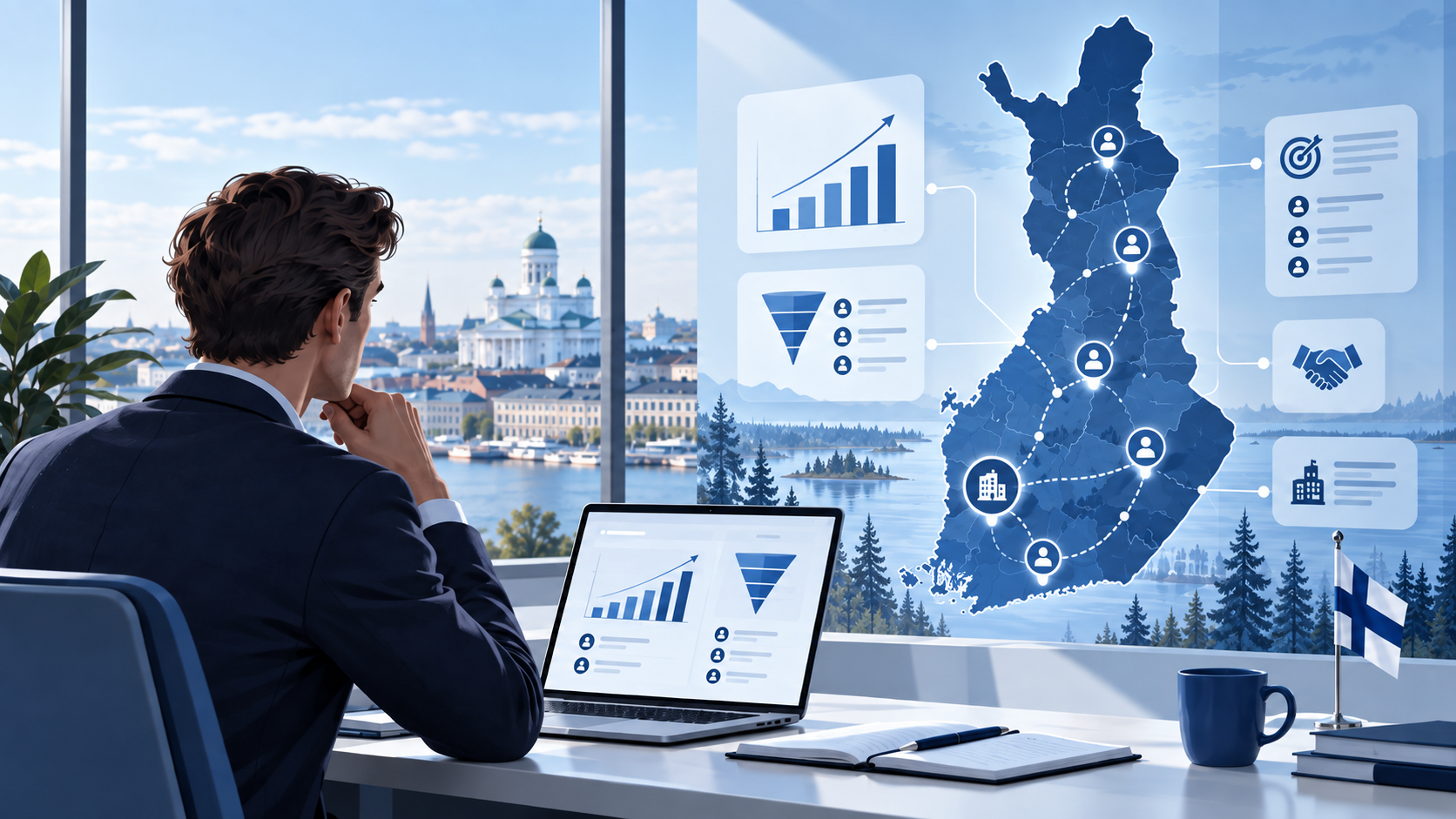
Doing business in Finland can look deceptively straightforward for a foreign technology company. The country has sophisticated organisations, high levels of digital adoption and a relatively compact business market. Those characteristics make Finland attractive, while also raising the standard for entering it successfully.
For technology vendors, the challenge is often commercial traction. Many Finnish companies already use established digital systems, meaning a new supplier may need to replace or integrate with existing technology rather than introduce an entirely new category. In 2025, 79% of Finnish enterprises used cloud services, while 58% used ERP systems and 56% used CRM systems, according to Statistics Finland.
This article explains what makes Finland different for foreign tech companies, how those characteristics should influence account selection and sales messaging, and how to build an outbound motion that produces useful market evidence alongside pipeline.
Doing business in Finland means selling into a digitally mature market
Finland's digital maturity changes the starting point for a technology sales conversation. In 2025, 38% of Finnish enterprises used AI technologies, rising to 68% among companies with at least 100 employees. Adoption reached 80% in the information and communication sector, while 79% of enterprises used cloud services, according to Statistics Finland.
For foreign SaaS and technology companies, this means many potential buyers already have established systems and experience evaluating new technology. Basic category education may therefore carry less weight than questions around:
- where the existing setup creates measurable friction
- how the new solution integrates with current systems
- what implementation requires internally
- whether switching creates enough value to justify the disruption
- how the commercial case compares with keeping the current setup
A new CRM application, for example, is rarely competing with an empty space in the technology stack. It may be competing with an existing CRM, established workflows and the organisational effort required to change them.
That shifts the sales conversation towards business case, migration risk and measurable improvement. Product functionality still matters, but it needs to connect clearly to the buyer's existing operating environment.
Narrow the ICP before adding sales volume
Finland had a population of approximately 5.65 million at the end of 2025, according to Statistics Finland. For a B2B technology company targeting a specific combination of industry, company size and buyer profile, the realistic account universe can therefore become relatively narrow.
In a market of that size, loose targeting quickly wastes sales capacity and reduces the amount of useful market learning. Repeatedly approaching unsuitable accounts can also exhaust a meaningful share of the relevant account base.
Market entry should therefore begin with an account-level hypothesis that identifies which companies have both a credible use case and enough commercial potential to justify sales attention.
Useful filters could include:
- industry and employee count
- current technology environment
- geographic or organisational footprint
- evidence of expansion, transformation or technology change
- likely economic value of solving the problem
A structured Go-To-Market approach should turn those variables into identifiable account clusters rather than one broad Finnish target list. The next step is equally important: test whether those assumptions survive contact with the market.
Use Finland as a market for focused commercial validation
A relatively compact addressable market creates a reason to learn quickly. Instead of launching large outbound sequences immediately, foreign tech companies can use the first account cohorts to test a small number of commercial hypotheses. One segment might respond to an efficiency case, while another engages because of compliance requirements, integration challenges or pressure on internal capacity.
The purpose of early outreach is therefore wider than meeting generation. It should answer questions that shape the Finnish sales motion:
- Which account profile converts into conversations?
- Which problem creates enough relevance to secure a meeting?
- Which job functions engage first?
- Where does interest disappear during qualification?
- Which objections repeat across accounts?
Those signals provide better information than top-of-funnel activity alone. A high email open rate means little if the same campaign produces few qualified conversations. Likewise, ten meetings provide limited validation when none of the opportunities progresses after discovery.
Build the case for replacing an existing solution
Digital maturity increases the importance of status quo competition. An established Finnish company may already have software supporting the process your product addresses, so even an attractive alternative creates implementation work, internal coordination and uncertainty.
For a SaaS company selling workflow automation to Finnish industrial businesses, a useful sales conversation should quantify:
- how much time the current process consumes
- where errors or delays create operational cost
- which systems the new platform must integrate with
- what internal effort implementation will require
- whether the expected improvement justifies switching
That gives sales a more concrete basis for qualification and helps distinguish interest from buying intent. A prospect may like the product while having little reason to replace its current setup this year, which has a direct impact on pipeline quality and forecast confidence.
Use outbound to reach a concentrated account universe
Foreign companies entering Finland still need a deliberate route into relevant accounts and decision-makers. Business Finland explicitly highlights direct access to Finnish companies, decision-makers and local networks as part of building commercial relationships in the market.
For foreign tech companies, Outbound Sales can create that access at scale. The outreach should focus on:
- clearly defined target accounts
- the right decision-makers inside each account
- a specific commercial or operational issue
- relevant proof from comparable customers
- structured follow-up across phone, email and LinkedIn
Make international proof locally relevant
Foreign technology companies often enter Finland before they have a Finnish reference case. That does not prevent them from building credibility, although the choice of evidence matters. A well-known international customer can establish legitimacy, but a buyer may learn more from a lesser-known customer that resembles their own organisation. Company size, technology environment, use case and implementation requirements can make a reference commercially relevant even when it comes from another country. Sales teams should therefore organise proof around the buyer's perceived risk.
Consider what the prospect needs evidence for:
- implementation complexity
- integration with existing technology
- measurable operational impact
- adoption among users
- time required before value becomes visible
As Finnish references emerge, they can gradually take a larger role in the commercial narrative. The first customer can therefore influence much more than initial revenue; it can reduce friction in subsequent sales conversations.
Map the buying process before forecasting the deal
Technology deals can create misleading pipeline when interest from one contact is treated as evidence that the wider organisation is ready to buy. For foreign suppliers, the risk is higher because internal purchasing structures may be unfamiliar and decision-making authority can sit across several functions.
The person who takes the first meeting may own the operational problem, while budget, technical approval or procurement sits elsewhere. A disciplined B2B Sales process should identify those dependencies early by clarifying who owns the business case, who evaluates technical implications, how purchasing approval works and what could delay implementation. That gives sales a more reliable basis for opportunity stages and forecast confidence than the enthusiasm of a single contact.
Measure whether Finland is working at account level
Market entry should become more informed with every account contacted. The CRM needs enough structure to show whether the Finnish Go-To-Market model is improving. Rather than reviewing total activity in isolation, management should look at conversion across the commercial journey. Useful measures include:
- target account to meeting conversion
- meeting to SQL conversion
- opportunity creation by ICP segment
- stage progression and sales-cycle length
- pipeline generated against sales capacity
Lost opportunities should also be categorised properly. There is a meaningful difference between losing because the proposition lacks relevance, because timing is poor or because the buyer chooses an incumbent supplier. Over several sales cycles, those patterns show where the market-entry model needs adjustment.
The company may discover that a particular vertical produces significantly better conversion, that enterprise sales cycles are longer than expected or that one use case consistently creates executive engagement. Each finding can influence the next round of account selection and resource allocation.
Build the Finnish sales motion around what makes the market different
Doing business in Finland gives foreign tech companies access to a digitally mature market where potential customers often already have established technology and experience evaluating new solutions. The country's relatively compact size also makes precision more valuable because the relevant account universe can narrow quickly.
A practical Finnish market-entry model should therefore:
- define a narrow ICP before increasing outreach volume
- build messaging around improvement to an existing setup
- treat implementation and switching risk as part of the business case
- use outbound conversations to validate market assumptions
- measure conversion at account level and refine the model continuously
For companies entering Finland or refining an existing market-entry motion, explore VAEKST's Go-To-Market services, Outbound Sales or broader B2B Sales offering.
Let's have a chat about your GTM
Have a virtual cup of coffee with one of our sales experts to explore collaboration opportunities.