Booking B2B appointments: automation, timing, tactics
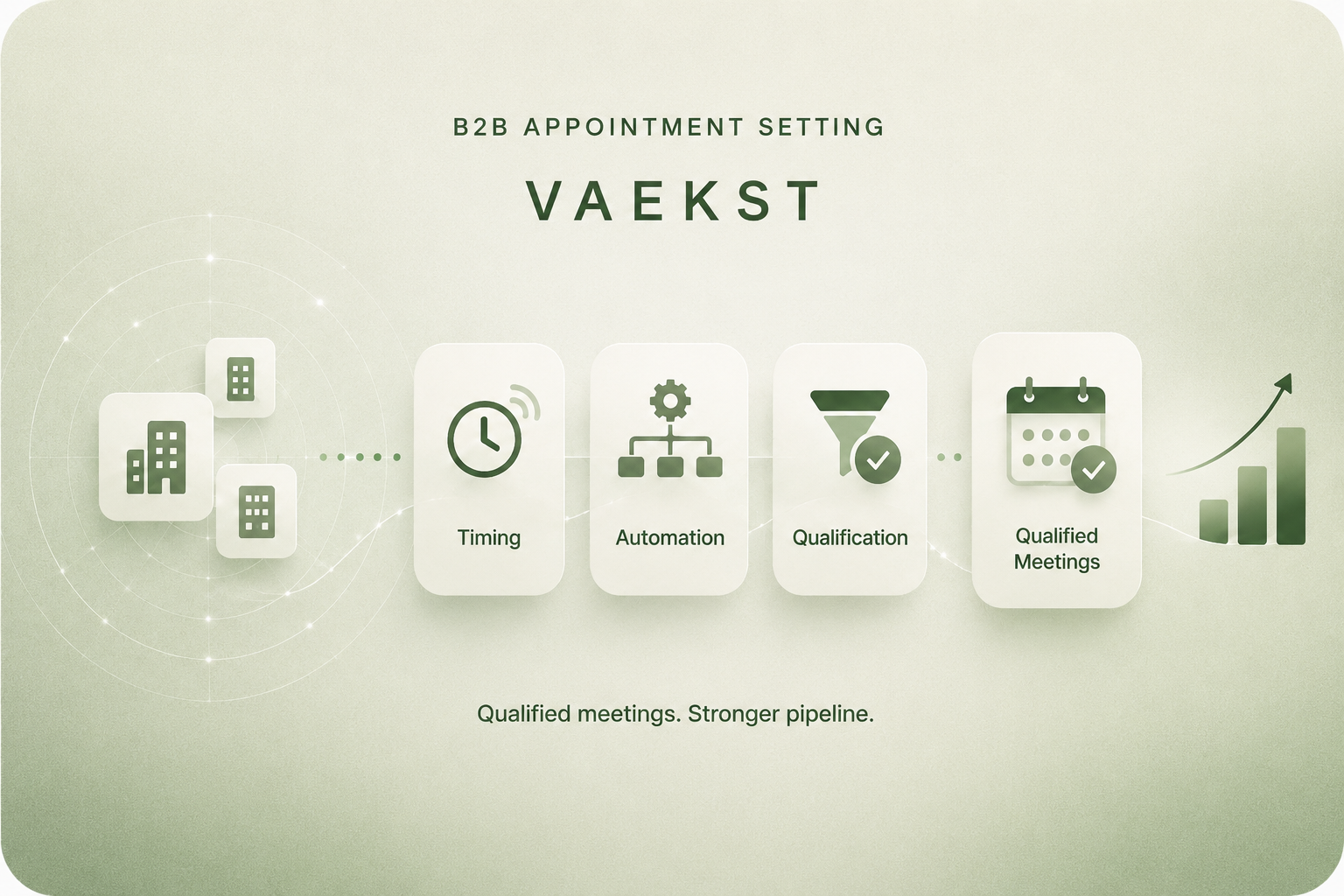
Booking B2B appointments has become more technical data-led and far more dependent on timing. Decision-makers rarely respond to generic messages, and more touchpoints do not automatically create more qualified meetings. The commercial question is how to build an appointment-setting model that can create volume without wasting sales capacity.
For many B2B companies, the friction sits between activity and qualification. Marketing delivers lists, outbound teams activate sequences, SDRs book meetings, and account executives spend time on conversations that should never have entered the calendar. Effective lead booking starts with account selection. The goal is to identify accounts with real commercial relevance and qualify the dialogue early enough that sales only spends time on meetings with clear pipeline value.
Appointment setting should start before first contact
Many companies evaluate appointment setting based on output: booked meetings, show rate and conversion to opportunity. These metrics are useful, but they only reveal quality after much of the work has already been done. A better model starts earlier. Before a lead is contacted, the team should understand:
- Why the account is relevant now
- What makes the conversation timely
- Who is likely to own the problem internally
- Whether the account shows signs of buying readiness
- How tightly the lead must be qualified before booking
This moves appointment setting away from mechanical outreach and closer to commercial prioritisation. When account selection, messaging and qualification work together inside a structured outbound sales process, sales spends less time sorting after the meeting and more time developing the right opportunities.
Automation should improve precision
Automation creates value when booking B2B appointments because it removes manual work without making the dialogue feel generic. It works best in the parts of the process where consistency matters more than memory. This includes:
- Account research and data enrichment
- Trigger-based prioritisation
- Sequence management across channels
- CRM updates and lead scoring
- Follow-up based on engagement
- Reporting on meeting quality and SQL rate
The commercial problem appears when automation becomes a volume engine without clear quality criteria. You may get more emails sent, more call activity and more meetings booked, but the pipeline becomes harder to forecast. Automation should instead create better timing and context. If an account visits a relevant page, hires into the sales organisation, opens a new Nordic office or engages with content around a specific problem, that should influence outreach. Not as a random data point, but as part of a clear prioritisation logic. This is where tools such as Pitchbound become relevant. Technology can support outbound execution with signals and structured activity, allowing the team to spend more energy on the conversation and less on manual coordination.
Timing determines whether outreach feels relevant
Timing in B2B sales is rarely about finding a perfect moment. It is about understanding which signals make a conversation more natural to start. A useful timing framework can be built around four signal types.
1. Organisational signals: New leaders, funding, acquisitions, expansion, restructuring or major recruitment can indicate that the company is moving. That movement often creates space for new supplier conversations.
2. Commercial signals: Slower growth, new markets, high churn, low pipeline coverage or a revised ICP focus can make sales and marketing initiatives more urgent.
3. Behavioural signals: Website visits, content engagement, webinar sign-ups and LinkedIn interactions show that an account has already touched the topic.
4. Relationship signals: Previous dialogue, shared connections, network proximity or existing brand awareness can reduce friction in the first conversation.
Qualification protects sales capacity
Lead booking without qualification fills calendars. Qualified booking creates pipeline. The difference lies in how clearly the team defines what a good meeting requires. Many sales organisations work with criteria that are too broad, where a meeting counts as a success if the person roughly fits the ICP and accepts an invitation. That is too weak when the goal is revenue. A useful qualification model should assess:
- Account fit: Does the company match the ICP, segment, size and market?
- Problem fit: Is there a clear business challenge?
- Stakeholder fit: Are we speaking to someone who can influence the process?
- Timing fit: Is there a signal that makes the dialogue relevant now?
- Next-step fit: Is there a clear reason for sales to progress the meeting?
This is also where sales enablement becomes critical. Qualification requires a shared language, clear CRM fields, a consistent meeting structure and feedback loops between SDRs, Account Executives and marketing. Without that operating rhythm, appointment setting becomes too dependent on individual judgement.
A simple framework for booking better B2B appointments
Booking B2B appointments effectively depends on meeting quality, account prioritisation, follow-up and CRM discipline. When these elements work together, the process becomes easier to manage and sales receives meetings with clearer pipeline potential.
1. Define meeting quality before activity starts
Start by deciding what a good meeting means in your business. The answer will differ depending on segment, deal size and sales process. For a SaaS company, a good meeting might require a clear need, technical fit and access to a relevant decision-maker. For a consultancy, the quality of the meeting may depend more on strategic problem understanding, budget horizon and access to senior stakeholders. Once the definition is clear, SDR teams can prioritise better. They know when to push for a meeting, when to nurture the account and when to close the dialogue.
2. Build account lists around buying probability
A long lead list rarely improves performance by itself - it usually creates more work. Account lists should be built from a combination of ICP fit and current signals. This could include industry, company size, technology stack, geographic expansion, funding, new hires or engagement with relevant topics. When lists become more precise, the outreach team has better conversations because the message can be shaped around the recipient’s situation.
Qualification also starts before first contact, because the team already knows why that specific account deserves attention. This is central to B2B lead generation: the job is not only to find leads, but to identify the accounts where dialogue has the highest likelihood of developing into real pipeline.
3. Use automation to prioritise follow-up
Many outbound processes lose momentum in follow-up. The first touchpoint goes out, the SDR follows up a few times, and then the account disappears into the CRM. Automation can solve this when used with discipline. A useful model can prioritise follow-up based on:
- Opens and clicks on relevant messages
- Website visits after outreach
- LinkedIn engagement from the same account
- Previous conversations or positive replies
- New triggers after a period without response
4. Make qualification concrete in CRM
CRM should reflect the sales process, not just record activity. If booking B2B appointments is going to support better forecasting, the CRM must show why a meeting was booked. That requires fields and processes that sales leadership actually uses. Relevant fields can include:
- Primary trigger
- ICP score
- Stakeholder level
- Problem area
- Qualification status
- Next commercial step
- SDR assessment of meeting quality
- AE feedback after the meeting
How to work more strategically with B2B appointment setting
An effective appointment-setting model requires close alignment between strategy and execution. It needs to be simple enough for SDRs to use every day and precise enough for sales leadership to make better decisions. Start with these questions:
- Who do we most want to engage over the next six months?
- What makes them relevant to contact right now?
- When is a meeting too weak to pass on to sales?
- What feedback should AEs provide after every meeting?
- Which CRM data points are necessary for better forecasting?
The answers make the process more concrete. Once the process is clear, sales leadership can automate the right parts of the workflow and make meeting quality more consistent across the SDR team.
When appointment setting becomes a pipeline function
Booking B2B appointments effectively creates more than calendar activity. It helps the sales organisation focus on accounts where timing, fit and business problem are connected. When those elements are embedded in CRM, sales enablement and continuous feedback, appointment setting becomes a genuine pipeline function.
VAEKST has delivered 9,500+ Sales Qualified Leads for Nordic B2B companies and works with appointment setting, outbound and qualification as one connected growth discipline. Read more about our approach to outbound sales, B2B lead generation, sales enablement and the technology behind Pitchbound.
Let's have a chat about your GTM
Have a virtual cup of coffee with one of our sales experts to explore collaboration opportunities.