Overcoming budget lock in enterprise sales
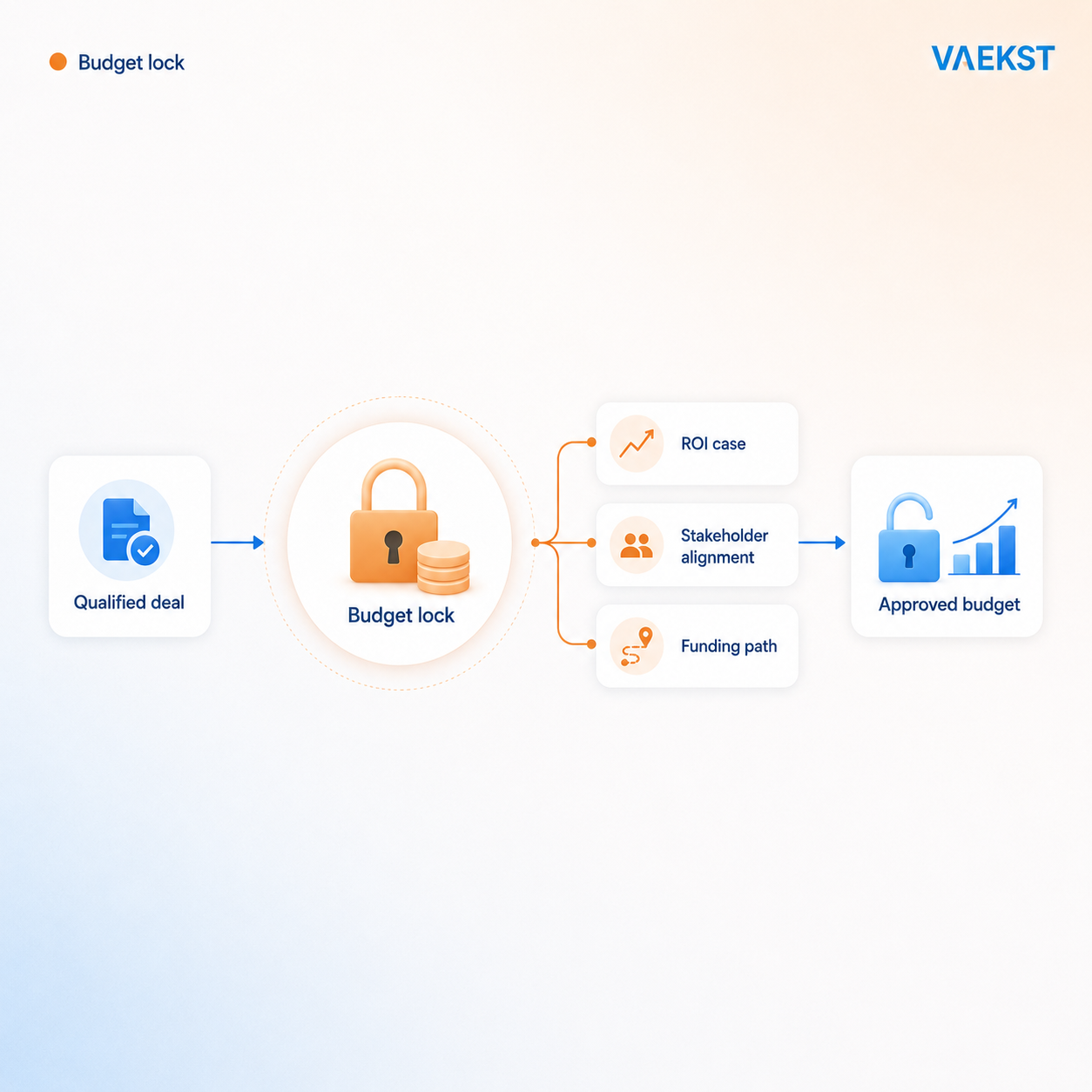
Budget lock in enterprise sales often appears late in the buying process, after discovery meetings have taken place and internal stakeholders have expressed genuine interest. The opportunity may be relevant. The commercial problem may be recognised. The buyer may even prefer your solution. Yet the deal stalls because the organisation has no approved budget, spending has been frozen or another initiative has secured priority. For sales leaders in professional services, industrial companies and B2B SaaS, this creates a costly pipeline problem. Sales teams spend months progressing opportunities that lack a credible path to funding, while forecasts continue to treat them as active deals.
Overcoming budget lock requires more than improved objection handling. It depends on how effectively the sales process establishes financial relevance, connects the investment to executive priorities and equips the buyer to secure internal approval. In this article, we explore how enterprise sales teams can address budget lock earlier and improve the commercial quality of their pipeline.
Why budget lock creates an enterprise sales efficiency problem
Enterprise sellers often discover budget constraints only after investing significant time in an opportunity. By that point, the deal may have passed several qualification stages, involved technical stakeholders and reached proposal stage, creating the impression of commercial maturity even though the internal funding process remains unclear. This creates false pipeline confidence. A deal with no identified budget owner, no investment process and no internal commercial case carries far more risk than the CRM stage suggests. When several opportunities share this weakness, sales leaders lose visibility into likely revenue and account executives spend time on deals with limited buying momentum. Budget lock therefore affects more than conversion as it reduces sales capacity, extends sales cycles and weakens forecast accuracy.
The first step is to recognise that “no budget” can describe several different situations:
- No budget has been allocated to the problem
- Existing budget belongs to another department
- Available funding has been committed elsewhere
- The buyer cannot justify reallocating investment
- The organisation has introduced a temporary spending freeze
Qualify the funding path before the proposal stage
Budget qualification should go beyond asking whether money is available. In complex enterprise sales, the initial contact may understand the problem without controlling the investment. They may also be unfamiliar with the internal process for funding an initiative outside the annual planning cycle. A commercially useful discovery process should establish:
- Which budget could fund the initiative
- Who owns or influences that budget
- How exceptions and reallocations are approved
- Which business case requirements apply
- What has received funding under similar circumstances
These questions reveal whether the buyer faces an absolute restriction or an internal prioritisation challenge. Qualification frameworks such as MEDDICC are useful here because they connect the commercial opportunity to economic ownership and decision criteria. The Economic Buyer matters particularly when funding must be secured across functions or approved above the initial stakeholder’s level. Sales teams should also distinguish between budget confirmation and funding confidence. A buyer saying “we should have budget” does not provide enough evidence for reliable forecasting. The deal becomes more credible when the account has identified the source of funds and mapped the approval route. A structured B2B sales process helps sellers identify these gaps before expensive resources are committed to proposals, workshops or technical validation.
Build the ROI case around the cost of the current state
Budget discussions become difficult when the solution is positioned primarily through features, deliverables or broad strategic benefits. Enterprise decision-makers need to compare the proposed investment with other priorities competing for the same resources. The seller must therefore make the economics of the current state visible. Gap Selling provides a useful structure. The seller explores the distance between the current situation and the desired future state, then quantifies how the gap affects commercially relevant outcomes.
For a B2B SaaS company entering the Nordics, the current state could involve slow market penetration, inconsistent outbound activity or limited access to local decision-makers. The business case should connect those conditions to delayed annual recurring revenue and higher market-entry risk. For an industrial company, the issue may involve poor visibility across target accounts, long sales cycles or underused CRM data. The financial impact could appear through lower conversion, inefficient sales coverage or missed expansion opportunities. For a professional services firm, budget lock may be easier to address when the commercial case shows how referral dependency affects pipeline predictability and consultant utilisation. A simple formula can help structure that comparison for internal decision-makers:
Cost of the current state + value of the desired outcome + risk-adjusted investment case
The calculation does not need false precision. It needs credible assumptions, relevant metrics and agreement from the stakeholders involved.
Help the buyer compete for internal budget
Enterprise opportunities rarely compete only against direct alternatives. They compete against recruitment plans, operational programmes and existing transformation projects. Your buyer may recognise the value of the solution while lacking the materials or internal influence required to secure funding. Buyer enablement becomes central at this stage. The sales team should make it easier for the internal sponsor to explain the initiative to finance leaders and executive stakeholders who have not participated in the sales process.
Useful buyer-enablement materials include:
- A concise executive business case
- An agreed impact model
- A phased implementation plan
- Evidence relevant to the buyer’s industry
- A clear summary of implementation risk
The material should use the organisation’s own commercial language. If leadership focuses on margin, capacity or market expansion, the case should connect the investment to those priorities rather than relying on the seller’s preferred terminology. This is where sales enablement affects conversion directly. A well-prepared account executive can help the buyer navigate internal funding discussions with clear messaging, relevant evidence and disciplined opportunity management, rather than simply resending the proposal and waiting.
Use account planning to identify alternative funding routes
Budget lock often reflects organisational structure rather than a lack of financial capacity. An initiative may create value across several departments while the original stakeholder carries the full investment request. In these situations, broader account mapping can reveal additional sponsors or budget owners. For example, a sales technology investment may improve revenue operations, management reporting and account execution. A market-entry programme may support regional leadership while also contributing to corporate growth targets.
Account-Based Marketing can support this process by coordinating engagement across the buying group. Rather than relying on one contact to carry the full internal case, sales and marketing can build relevance with the stakeholders who influence commercial approval. This does not mean bypassing the original sponsor. It means helping them create wider support. Map the account by asking:
- Who benefits financially if the initiative succeeds?
- Which executive priority does the project support?
- Who carries the cost of maintaining the current approach?
- Which department has previously funded related initiatives?
Reduce commitment risk through commercial sequencing
Even when the ROI case is credible, the buyer may hesitate because the initial commitment feels too large. A phased commercial structure can make the investment easier to approve, provided each phase has a clear purpose and measurable decision point. For a Nordic Go-To-Market programme, the first phase could validate ICP assumptions and messaging before a wider market rollout. For a sales enablement initiative, the organisation could begin with pipeline analysis and process design before implementing broader CRM changes.
A phased commercial structure should preserve the value and ambition of the work while reducing uncertainty and creating evidence before the buyer makes the next commitment. A useful phased approach should clarify:
- What the first phase will validate
- Which metrics determine progression
- What resources the buyer must provide
- How the phase contributes to the wider business case
Poorly designed pilot projects can delay decisions and consume sales capacity without creating a clear route forward. The seller should therefore agree on the success criteria and expansion logic before the first phase begins.
Manage budget-locked deals differently in the pipeline
Budget-locked opportunities should not remain in late-stage pipeline categories simply because the buyer likes the solution. Sales leaders need CRM stages and forecast criteria that reflect commercial evidence. An opportunity awaiting budget approval should include a documented funding route, named stakeholders and a realistic decision date. Without these elements, the deal belongs in a lower-confidence forecast category. Useful management questions include:
- Has the buyer quantified the impact of the problem?
- Has an economic buyer reviewed the case?
- Is the funding source identified?
- Does the internal sponsor have a clear approval plan?
- Has the organisation agreed what happens next?
This discipline protects sales efficiency. It also helps managers direct coaching towards the actual obstacle rather than encouraging repeated follow-up. HubSpot or another CRM can support this through mandatory qualification fields, deal-risk indicators and reporting by funding status. The system should help the sales team identify weak opportunities early rather than create additional administration.
How to overcome budget lock in enterprise sales
Budget lock becomes easier to address when funding is treated as part of the buying process from the beginning. Enterprise sellers need to understand how investment decisions are made, quantify the commercial impact of inaction and provide buyers with a credible internal case. They also need to manage budget-constrained opportunities according to evidence rather than optimism. The practical priorities are:
- Map the funding process during discovery
- Connect the investment to measurable commercial impact
- Equip internal sponsors for executive approval
- Identify wider stakeholders and alternative budgets
- Use forecast criteria that reflect funding confidence
These practices improve sales efficiency because teams spend more time on opportunities with a realistic path to revenue. They also improve the quality of executive conversations by shifting the discussion from available budget towards investment priority and expected return.
Explore how VAEKST helps B2B companies improve sales enablement and commercial execution across complex Nordic markets.
Let's have a chat about your GTM
Have a virtual cup of coffee with one of our sales experts to explore collaboration opportunities.