Outbound sales strategy: building predictable B2B pipeline
Many B2B companies generate activity through outbound sales, yet still struggle to turn that effort into a predictable pipeline. Teams send emails, make calls, build sequences and book meetings, but the commercial value drops when outreach is measured primarily on volume rather than relevance and conversation quality.
When outbound is managed as an activity rather than a commercial strategy, quality quickly declines. The pipeline starts to fill with meetings that lack clear momentum, and decision-makers begin to experience outreach as noise because the message does not connect clearly enough to their business priorities.
A strong outbound strategy creates structured conversations with the right decision-makers at the right time. It is built on insight into their market, role and commercial agenda. In this article, we look at how sharper ICP definition, insight-led messaging, multichannel execution and sales enablement can turn outbound activity into a more predictable B2B pipeline.
Why many outbound strategies lose effect
Many outbound initiatives lose traction because they begin with channels and activities before the commercial foundation is clear. Companies often select tools, build sequences and assign SDR activity before they have defined which:
- Accounts are genuinely attractive
- Pains drive action
- Buying triggers create urgency
- Commercial positioning makes them relevant
Outbound gets weaker when the message sounds like it could have been sent to the entire market. Decision-makers respond more strongly to outreach that shows an understanding of their account and the commercial problems they are already trying to solve.
The commercial relevance framework
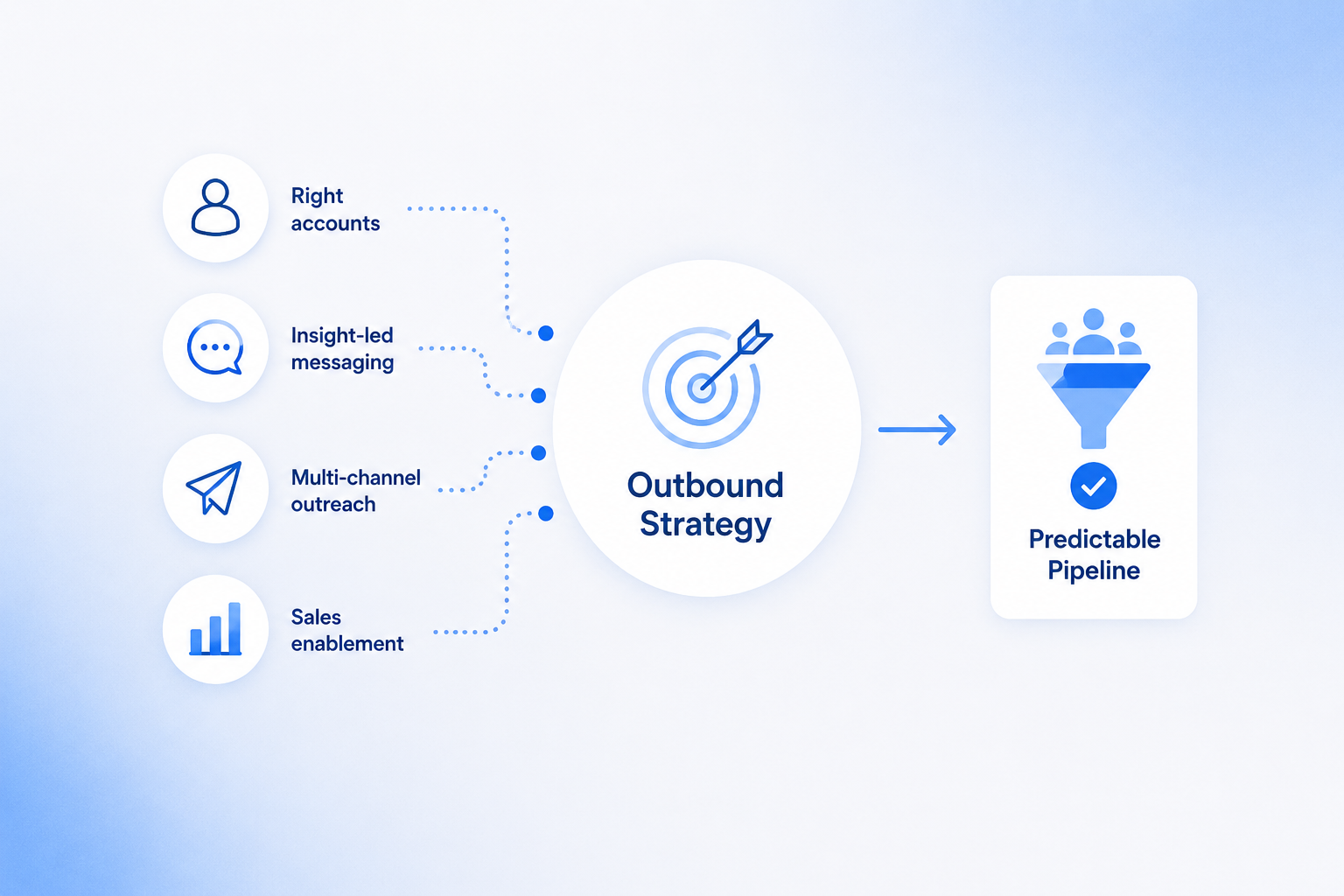
An outbound strategy that creates real pipeline is typically built on four layers. When these layers work together, outbound becomes a more connected commercial process as targeting, messaging, channels and pipeline management all support the same revenue objective:
- ICP precision
- Insight-led messaging
- Multichannel execution
- Sales enablement and pipeline discipline
1. Start with your ICP before you build lists
Effective outbound starts with sharp segmentation, which means an ICP needs to be more precise than “mid-sized companies in Denmark”. Company size and geography rarely explain where pipeline potential is strongest. High-performing outbound teams usually work with questions such as which:
- industries convert fastest?
- company types experience the strongest pipeline uncertainty?
- roles feel the problem most directly?
- signals indicate buying readiness?
- accounts have the highest commercial relevance right now?
This is where many companies underestimate the value of structured B2B lead generation. Effective lead generation is about more than finding additional companies to contact; it helps identify the accounts where relevance, timing and commercial potential overlap.
2. Use commercial perspectives to earn the meeting
Many outbound messages lose the recipient within the first few lines. Often, the language itself is not the main issue. The message simply lacks a commercial perspective that makes the conversation worth having. Decision-makers rarely book meetings because someone wants to “have a quick chat”. They are more likely to respond when outreach challenges their current thinking, highlights an overlooked problem or connects directly to a priority they are already working on.
A weak outbound message might sound like this: “We help companies improve their pipeline through outbound sales.” A stronger message would start from a more specific commercial perspective such as: “Many B2B companies generate plenty of sales activity, but still struggle with pipeline uncertainty because the right accounts are not being prioritised early enough.” The second version works better because it gives the recipient a business-relevant reason to reflect on their current situation. Good outbound requires a message that feels relevant to the recipient’s reality. They should quickly understand why you are reaching out and which commercial problem the conversation is about.
3. Build outbound as a multichannel system
Outbound performs poorly when channels operate in isolation. Emails are easy to miss, calls lack context, and LinkedIn activity can create visibility without moving the commercial dialogue forward. The most successful outbound strategies connect the channels in one coordinated motion:
- Social selling on LinkedIn builds familiarity with the right decision-makers
- Email introduces a relevant commercial perspective
- Phone outreach moves the dialogue forward through direct conversation
- Follow-up builds momentum across the buying process
- CRM data improves the next touchpoint
4. Sales enablement decides whether the pipeline can scale
Many companies manage to book meetings, but still struggle with inconsistent pipeline because the infrastructure behind outbound has not been built for scale. If CRM data is inaccurate, pipeline stages are unclear and qualification varies from person to person, it is difficult to ascertain which activities are actually creating commercial progress. Sales enablement plays a central role in an outbound strategy because it gives teams the structure needed to measure, repeat and improve performance. A good outbound strategy requires:
- Clear pipeline stages
- Defined qualification criteria
- Consistent CRM hygiene
- Structured account prioritisation
- Visible attribution across pipeline sources
How to evaluate your outbound strategy
A useful way to assess your current outbound strategy is to look beyond activity metrics. Meeting volume still matters, but it does not tell the full story. The more commercially relevant questions are:
- Are the right accounts entering the pipeline?
- Do meetings progress beyond the first conversation?
- Are decision-makers engaging with the commercial problem?
- Does CRM data show clear patterns in conversion and momentum?
- Can sales leaders identify which messages and segments create the strongest pipeline?
If these questions are difficult to answer, the outbound model needs more structure. Adding activity may create short-term movement, but it rarely improves pipeline quality unless the underlying targeting, messaging and enablement are strong enough.
Technology alone does not create pipeline
Teams invest in more tools because they expect technology to improve outbound performance on its own. In practice, the effect depends on how clear the strategy behind the tools is. If the ICP is unclear, the messaging is generic and the CRM structure does not support prioritisation, automation will often scale the same problems faster. More sequences do not necessarily create better pipeline if the recipient does not experience the outreach as relevant.
Technology should therefore be connected directly to the commercial model. Outbound platforms such as Pitchbound can support structured outreach, account prioritisation and insight-led sales execution, but the impact depends on how well strategy, messaging and the sales process work together.
Read more about how VAEKST works with outbound sales, B2B lead generation and sales enablement, or see how Pitchbound supports outbound execution.
Let's have a chat about your GTM
Have a virtual cup of coffee with one of our sales experts to explore collaboration opportunities.