Lead management for professional services: why a CRM isn’t enough
The CRM has become the default answer to commercial structure in professional services. Once the system is live, contacts are stored, deals are tracked and dashboards are available. Yet the real lead management challenge often appears after implementation, when ownership becomes unclear, follow-up varies by person and qualification depends too much on individual judgement.
That is where lead management in professional services becomes commercially important. CRM gives you the infrastructure, but the value comes from how leads move through the organisation and how much of the process can be structured before senior commercial judgement is needed. For advisory, consulting, IT services and other expert-led firms, the buying journey is rarely linear. Signals often appear months before a serious buying process begins. This article explores why CRM alone is rarely enough, and how professional services firms can structure and automate lead flow to create stronger pipeline control.
Why CRM adoption alone does not solve lead flow
A CRM is only as strong as the commercial process behind it. Many professional services firms use HubSpot or another CRM to capture leads, manage contacts and track opportunities. That creates a foundation, but it does not automatically create a reliable lead flow.
The problem usually appears in the handover points. A lead enters the database, but nobody knows whether it belongs with a partner, a business developer or a nurture sequence. When a contact engages with content, the signal often remains a marketing data point rather than a commercial next step. Even booked meetings can be difficult to assess if qualification criteria change depending on who takes the call. This leads to several predictable issues:
- High-intent leads receive slow follow-up
- Low-fit leads take time from senior commercial profiles
- Marketing cannot see which campaigns influence qualified pipeline
- Sales teams struggle to prioritise outreach
- Partners rely on memory instead of process
For professional services, the opportunity cost is significant. Senior experts often have limited time for business development, and their attention should go towards the accounts most likely to become valuable client relationships. A better CRM setup helps, especially when supported by strong HubSpot optimisation. Still, the real work is to define the operating model around lead capture, scoring, routing and follow-up.
How to structure lead management in professional services
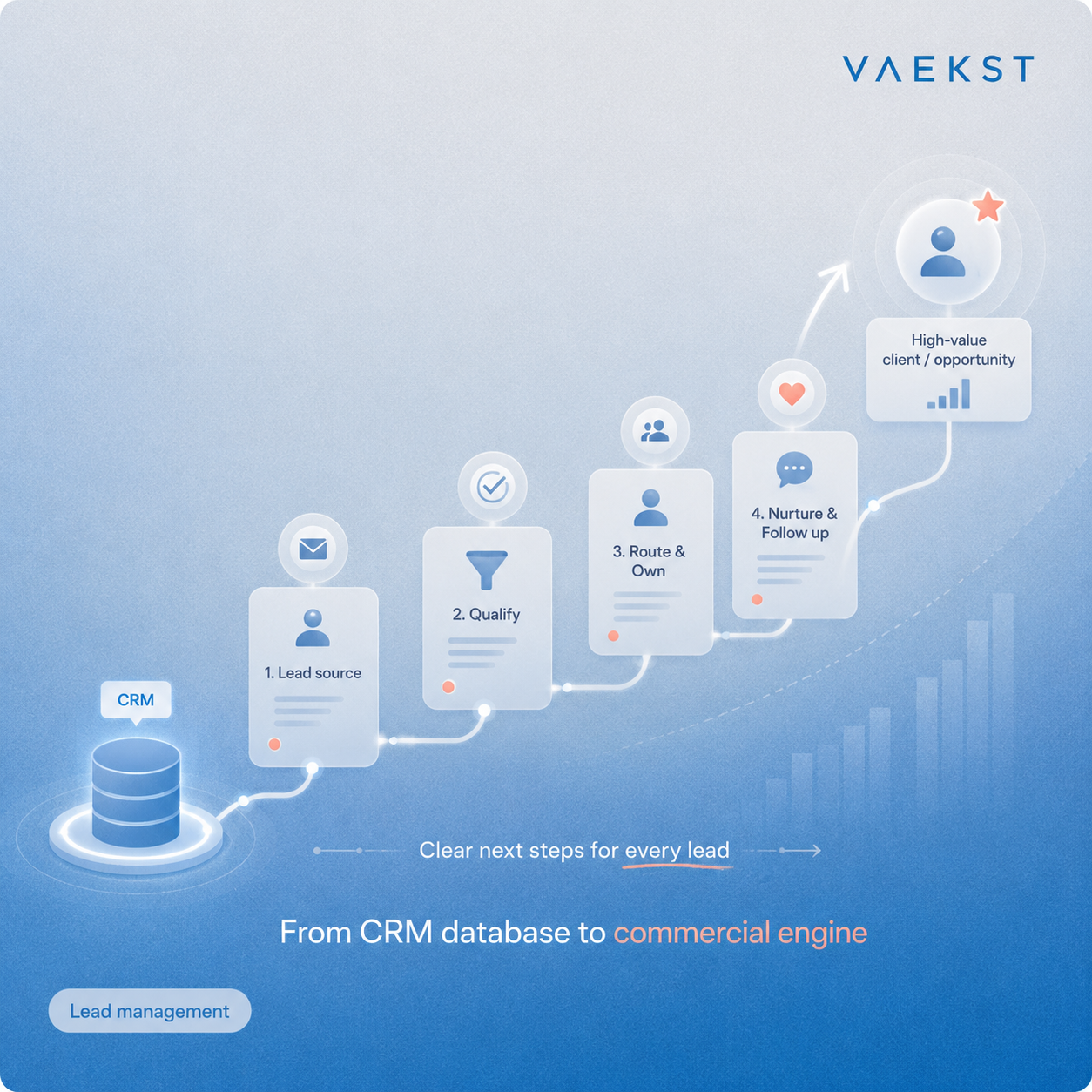
Lead management starts with a simple commercial principle: every lead should have a clear next step. That does not mean every lead should be contacted by sales. It means every signal should be interpreted based on fit, intent and timing. For professional services firms, this typically requires four layers.
1. Clear lead sources and attribution
If all leads are treated the same, performance analysis becomes difficult. A referral from an existing client, a contact from an executive roundtable and a cold inbound form submission all carry different commercial meaning. They often require different follow-up, qualification and ownership. Your CRM should capture lead source in a way that supports decision-making. This includes channels such as organic search, paid campaigns, LinkedIn, events, referrals, outbound and partner networks.
Proper attribution gives the commercial team a clearer view of which activities create the right type of pipeline. A professional services firm might discover that webinars create many leads but few qualified opportunities, while executive breakfasts generate fewer leads with higher conversion. That insight changes budget allocation, partner involvement and campaign planning. This is where B2B marketing needs to connect directly with commercial execution. Marketing performance should go beyond engagement and be measured by contribution to qualified pipeline and revenue influence.
2. Qualification criteria that reflect complex buying journeys
Professional services rarely sell simple products. Buyers are often evaluating trust, expertise, risk and internal alignment before they are ready to move. That means lead qualification should go beyond surface-level firmographics. Company size and industry still matter, but they are only part of the picture. A strong qualification model should also consider strategic fit, buying trigger, stakeholder seniority, urgency and potential lifetime value.
Frameworks such as MEDDICC, BANT or Gap Selling can help structure the logic, but they should be adapted to your commercial reality. A management consultancy, an IT consultancy and an engineering advisory firm will not define a qualified lead in exactly the same way. For many professional services firms, useful qualification questions include:
- Is there a clear business issue behind the engagement?
- Does the account match our strongest service lines?
- Is the stakeholder close enough to budget or strategic influence?
- Have we seen recent trigger events such as expansion, restructuring or regulation?
- Can we create meaningful value beyond a one-off project?
3. Automated routing without losing human judgement
Automation earns its place when it removes the small operational decisions that create delay in lead flow. In practice, that means routing a high-fit lead from a target account to the right commercial owner, moving low-intent content engagement into a nurture flow or creating a follow-up task when a dormant account revisits key service pages. Used well, CRM automation gives the commercial team faster response times and more consistent execution without forcing every lead through the same process. Useful automation points include:
- Assigning leads based on segment, geography or service interest
- Creating follow-up tasks after high-intent behaviour
- Moving leads into nurture sequences when they are not sales-ready
- Notifying account owners when target accounts engage
- Updating lifecycle stages based on agreed criteria
This is particularly important in firms where senior consultants, partners or directors are involved in sales. Automation protects their time by filtering noise before it reaches them. It also improves response time. When a prospect shows buying intent, the firm should not depend on someone noticing a form submission in a shared inbox.
4. A structured nurture model for long buying journeys
Professional services buyers often move slowly because the decision carries internal risk. They need confidence before they are ready for a conversation - and that makes lead nurturing essential. A lead that is not ready for sales today may still become highly valuable in six months. The question is whether your firm stays relevant during that period.
Effective nurture combines commercial insight with behavioural signals. A CFO engaging with content on operational efficiency should not receive the same follow-up as a CIO reading about system integration. A senior stakeholder from a target account should be treated differently from a junior contact with limited influence. Effective nurture keeps the firm commercially relevant while timing matures, using buyer behaviour and account fit to decide when a lead needs education, follow-up or a new commercial touchpoint. This is where B2B lead generation and content strategy need to work together. Lead generation creates the signal. Nurture develops that signal into a stronger commercial opportunity.
The role of sales enablement in lead management
Lead management becomes difficult when qualification criteria shift across the organisation. Partners may prioritise relationship strength or strategic account value, while business developers often focus on meeting quality and conversion potential. Marketing, meanwhile, tends to look at engagement data and campaign source. None of these perspectives are wrong. The issue appears when there is no shared operating model for deciding which leads deserve attention, who owns the next step and what should happen after each interaction.
Sales enablement creates that operating model. It turns lead management into a set of agreed commercial standards that can be used across teams, service lines and markets. This typically includes:
- Lead stage definitions
- Qualification standards
- Follow-up rules
- CRM field governance
- Dashboard design
- Sales playbooks for different lead types
Once these standards are in place, lead management becomes easier to inspect. Leadership can see how many leads enter each stage, where conversion drops, how quickly sales follows up and which sources create qualified opportunities. That visibility changes the quality of management conversations. Instead of relying on opinions about lead quality or follow-up discipline, the commercial team can look at the actual flow:
- Where are leads getting stuck?
- Which sources produce meetings but few opportunities?
- Which service lines convert best?
- Which segments deserve more focus?
From CRM database to commercial engine
A CRM should be more than a place where contacts are stored. For professional services firms, it should become the infrastructure behind better commercial decisions. That requires more than clean data. It requires a structured lead management model that connects marketing signals, sales follow-up and senior stakeholder involvement.
When lead flow is clear, the commercial organisation becomes faster and more focused. High-intent leads are prioritised. Nurture becomes more relevant. Partners spend time on better-fit opportunities. Marketing can prove its influence on pipeline. The CRM still matters. It just needs the right commercial logic around it.
Explore how VAEKST helps B2B companies strengthen HubSpot optimisation, B2B lead generation, sales enablement and B2B marketing.
Let's have a chat about your GTM
Have a virtual cup of coffee with one of our sales experts to explore collaboration opportunities.