How to build a B2B customer retention strategy
Recurring revenue becomes far more valuable when customers keep choosing to stay. For B2B SaaS companies and service businesses, acquisition often receives the majority of commercial attention. New logos are visible, pipeline is easy to report on, and new deals create immediate momentum. Yet growth becomes increasingly difficult when expansion at the top of the funnel is offset by customers leaving further down the revenue cycle.
A B2B customer retention strategy creates a more deliberate approach to protecting recurring revenue by connecting customer success with commercial data, relationship management and ongoing value creation.
In this article, we look at how to segment customers, identify retention risk and build customer success around measurable outcomes that support loyalty and recurring revenue.
Why B2B customer retention deserves commercial ownership
Retention is often treated primarily as a customer success metric. Commercially, its impact reaches much further. When a customer leaves, the business loses more than the next contract period. Future expansion potential disappears, acquisition investment has less time to generate a return, and the revenue team must replace the lost value before it can create net growth.
This becomes particularly important in businesses with recurring contracts or repeat purchasing behaviour. As the customer base grows, small differences in retention rates can materially change the amount of revenue carried into the next financial year.
Leadership teams should therefore understand gross revenue retention and net revenue retention alongside traditional sales metrics. Together, they show whether the commercial engine is creating new revenue while preserving the value already won.
Start your B2B customer retention strategy with segmentation
Customers rarely carry equal retention risk or equal future value. A useful retention model begins by segmenting the customer base according to commercial potential and the type of attention required. Account value is an obvious variable, but contract size alone gives an incomplete picture. A practical segmentation model should consider:
- Current account value: how much recurring revenue the customer contributes today
- Expansion potential: whether there is a credible opportunity to broaden the relationship
- Relationship depth: how widely the relationship extends across relevant stakeholders
- Strategic fit: whether the account matches the segments where your organisation creates the most value
A high-value account using only one part of your offering may deserve more proactive attention than a similarly sized account where adoption is already broad. This thinking closely resembles Account-Based Marketing, where resources are prioritised around selected accounts rather than distributed evenly across the market.
Connect customer success to measurable value
Retention becomes harder when supplier metrics are disconnected from the outcomes customers actually care about. A software provider may track logins and feature adoption, while the customer is judging whether the platform saves time or improves conversion. That link between usage and business impact should be established during the sales process. Discovery should clarify the customer’s current state and desired outcome, which can then carry into onboarding and account management. Gap Selling is useful here because it frames value around the distance between those two states.
Customer success teams should then measure progress against the agreed business outcome, rather than relying on implementation milestones alone. Completing onboarding may show progress, but commercial value appears when the solution contributes to measurable results. Documenting these outcomes in the CRM gives account managers a clearer basis for customer conversations and renewal discussions.
Identify retention risk before the renewal date
A renewal conversation should rarely contain surprises. By the time a customer explicitly says they are considering leaving, dissatisfaction or uncertainty may have existed for months. Effective retention processes identify those signals while there is still enough time to respond constructively. Relevant warning signs can include:
- Declining engagement: usage, participation or contact frequency starts moving downwards
- Unresolved friction: recurring issues remain open or require repeated escalation
- Stakeholder changes: a sponsor leaves the business or responsibility moves elsewhere
- Value uncertainty: the customer struggles to connect the relationship with measurable business impact
- Reduced commercial engagement: planned reviews are postponed or decision-makers become harder to involve
CRM structure matters because these signals often sit across different systems or individual account managers. A well-configured HubSpot setup can bring customer information into one commercial view and make retention risk easier to monitor systematically.
The goal is to build an account-health model that creates useful action. Too many health scores become reporting exercises because the underlying criteria are vague or nobody owns the response when risk increases. Define what each signal means, assign ownership and establish the next commercial action before the account reaches renewal.
Build relationships beyond the original buyer
B2B retention becomes vulnerable when the relationship depends too heavily on a single contact. If the original buyer changes role, leaves the company or loses influence over the budget, the account can quickly become exposed, particularly when other stakeholders have limited visibility into the value being created.
Account teams should therefore understand who uses the solution, who evaluates its commercial impact and who influences renewal. Where the relationship is concentrated around one contact, create relevant reasons to involve additional stakeholders through business reviews or customer insight.
Marketing can support this process as well. B2B Marketing should continue after acquisition by providing existing customers with relevant insights and content that helps them generate more value from the relationship.
Make renewal a value conversation
Renewal processes become unnecessarily transactional when the commercial discussion starts with contracts. A better foundation is the value already created. Before the renewal window, review the objectives established earlier in the relationship and document progress against them. Where results fell below expectations, understand the cause early enough to address it. This creates a more credible conversation because the account team can discuss the customer’s business context rather than relying on generic satisfaction statements.
The same process can reveal expansion opportunities. A customer that has successfully solved one commercial problem may have adjacent needs where your organisation can create additional value. Customer success therefore contributes directly to net revenue retention when teams can connect delivered outcomes with the customer’s next priorities.
Measure retention as part of the revenue engine
Gross revenue retention shows how much recurring revenue remains before expansion. Net revenue retention adds upsell and expansion, providing a broader view of how the existing customer base develops over time. Those measures should be supported by operational indicators that explain what is happening underneath the overall retention number. Depending on the business model, this could include renewal performance by customer segment or changes in account health over time.
The important part is segmentation. An overall retention rate can look healthy while a valuable industry or product line is deteriorating underneath it. Revenue leaders should therefore analyse retention in much the same way they analyse pipeline: identify where performance differs and investigate the commercial reasons behind the movement.
A practical framework for B2B customer retention
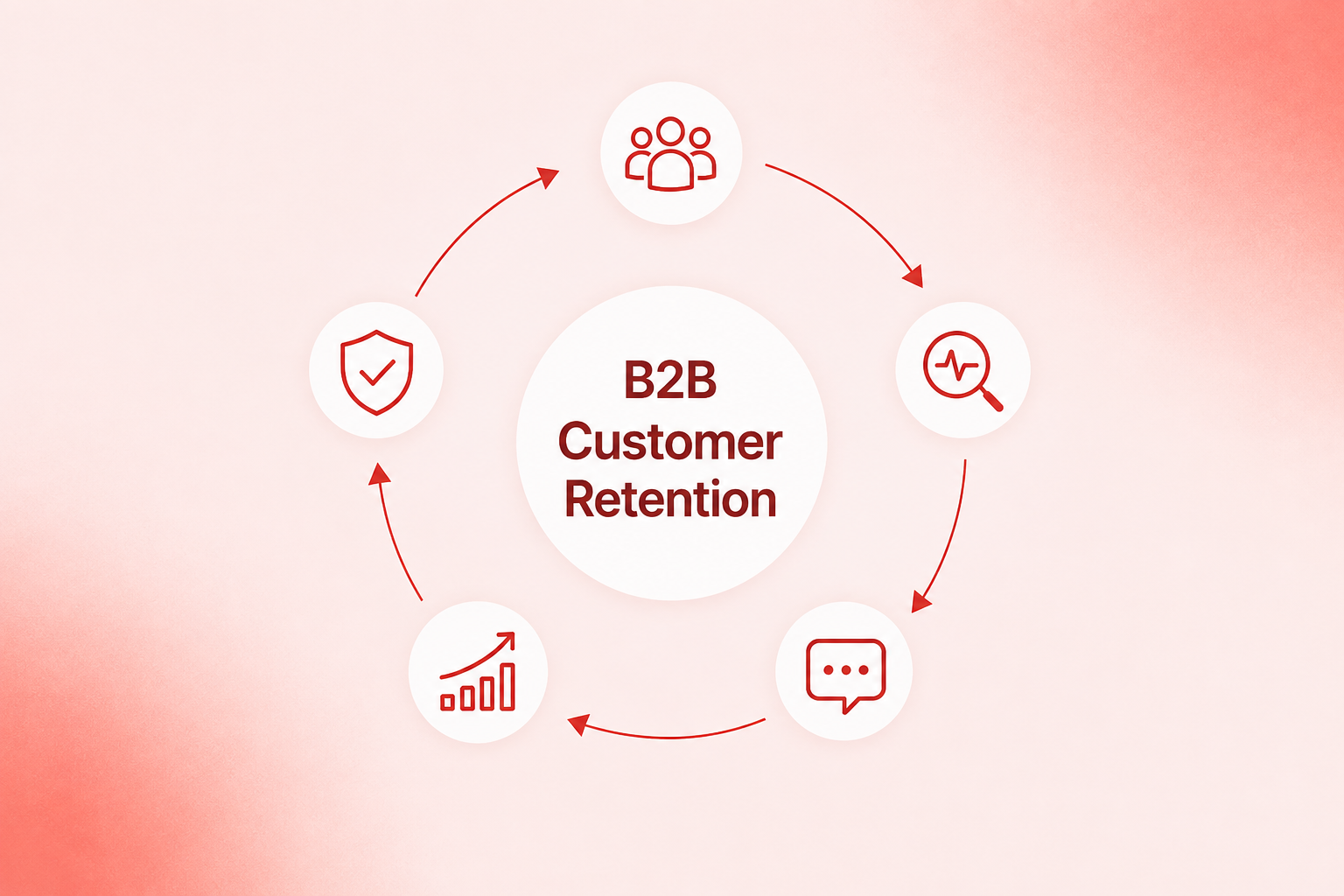
A useful B2B customer retention strategy can be organised around five recurring activities:
- Segment accounts by value and retention needs so resources reflect commercial importance
- Define customer outcomes during the sales process and preserve that context during handover
- Track value and account health continuously rather than waiting for renewal
- Develop relationships across the buying organisation to reduce dependency on individual stakeholders
- Connect retention with expansion planning once measurable customer value has been established
For commercially mature B2B organisations, the opportunity goes beyond lowering churn. Better retention creates a larger recurring revenue base from which future acquisition and expansion can compound.
Customer success, marketing and CRM infrastructure all influence that outcome. When they operate from the same customer context, leadership gains a clearer view of where recurring revenue is secure and where commercial intervention is required.
If you want to build a more structured retention setup around customer data, commercial processes and ongoing account development, VAEKST can help you turn customer retention into a more measurable part of your growth engine.
Let's have a chat about your GTM
Have a virtual cup of coffee with one of our sales experts to explore collaboration opportunities.