Expanding to the Nordics: B2B sales strategies that work
A successful b2b nordic market entry rarely fails because the product is irrelevant. It usually fails because the commercial approach travels poorly. Companies entering Denmark, Sweden, Norway or Finland often underestimate how much Nordic buyers expect from the first interaction. They are highly digital, well-informed and cautious with external vendors, and they do not respond well to generic international messaging, inflated claims or sales processes that feel too aggressive.
For B2B SaaS companies, industrial firms and professional services businesses, the Nordics remain attractive: mature markets, high trust levels and decision-makers open to specialised solutions when the business case is clear. But market entry takes more than translated messaging and a local hire. It requires a Go-To-Market strategy built around how Nordic buyers evaluate risk, build consensus and decide whether a new vendor deserves attention. This article explores how to prioritise the right Nordic markets, localise your positioning, validate demand through outbound sales and build a sales process that reduces buyer risk.
Why b2b nordic market entry requires localisation beyond language
Localisation is often treated as a marketing task: translating the value proposition, adjusting the website and adding a few local customer references. That is rarely enough. In Nordic B2B sales, localisation has to reach the commercial operating model. It affects which accounts you prioritise, which problems you lead with, how direct your outreach should be, what level of proof buyers expect and how much time you need to spend building trust before pushing for a decision.
Nordic decision-making differs by market and role. A CFO in Denmark may focus on efficiency and risk reduction, while HR leaders in Sweden often expect broader stakeholder alignment before moving forward. In Norway, operations leaders may respond better to practical use cases from similar companies. These are general patterns, not fixed rules, but they show why one Nordic sales playbook often needs market-level nuance.
The companies that gain traction fastest usually localise four commercial layers:
- Segmentation: Not every Nordic market should be entered at the same time. Start where your Ideal Customer Profile is most concentrated, the pain is most urgent and the buying trigger is easiest to identify.
- Messaging: Nordic buyers respond better to precise commercial relevance than broad ambition. Your message should show that you understand their market, constraints and decision context.
- Sales execution: Outbound cadence, channel mix and follow-up style should reflect local buyer behaviour. A sequence that works in the UK or US can feel too pushy in the Nordics.
- Proof: Nordic buyers look for credibility early. Local references help, but relevant industry proof, clear business cases and credible implementation stories can also reduce perceived risk.
Start with market prioritisation, not market presence
Many companies enter the Nordics by trying to cover the region too broadly. They see a combined market with similar cultures, high English proficiency and mature business infrastructure. That view is partly useful, but commercially dangerous.
Denmark, Sweden, Norway and Finland have different industry structures, decision styles and competitive dynamics. Sweden can offer scale, but the buying process may be slower in larger enterprise accounts. Denmark is often attractive for agile B2B market testing, especially when stakeholder access matters. Norway can be compelling in sectors such as energy, maritime, infrastructure and public-adjacent industries. Finland often requires a more specific understanding of local buying networks and technical decision-making. A sharper b2b nordic market entry plan starts with a practical assessment of where the commercial opportunity is easiest to activate. Before committing to a market, leadership should look at four questions:
- Which country has the highest density of target accounts?
- Where do you already have customer proof that feels relevant?
- Which market has the clearest buying triggers?
- Where can outbound sales create conversations within a realistic timeframe
Build your Nordic ICP around buying triggers
A generic ICP will not carry your Nordic expansion. Company size, industry and geography matter, but they do not explain why a decision-maker should engage now. For market entry, buying triggers are often more valuable than static firmographic filters. Relevant triggers could include a new market expansion, regulatory pressure, operational inefficiency, a leadership change, new funding, a system migration or visible hiring within a function you support.
For example, a B2B SaaS company selling compliance software should not only target “companies with 200–1,000 employees in regulated industries”. A more commercially useful ICP would identify companies experiencing new reporting requirements, international expansion or recent operational complexity that makes the current setup less sustainable.
This creates better outbound relevance. Instead of introducing your company as another vendor entering the market, you enter the conversation around a business event the buyer already recognises.
Adapt the sales conversation to Nordic buyer behaviour
Nordic buyers tend to value clarity, preparation and respect for time. They will often engage if the outreach is relevant, but they rarely reward exaggerated urgency or overly polished sales narratives. A good sales conversation starts with context:
- Why this account?
- Why this stakeholder?
- Why now?
This is where Challenger Sales logic becomes useful. Instead of leading with product features, lead with a market observation or commercial tension that the buyer recognises. The goal is not to provoke for the sake of it. The goal is to help the buyer see a problem more clearly than before. For example: “We are speaking with several Nordic SaaS companies expanding into enterprise segments. A recurring challenge is that pipeline growth looks healthy at lead level, but conversion drops once procurement and legal become involved. Is that something you are seeing as deal sizes increase?” This approach works because it is specific, relevant and easy to respond to. It gives the buyer a reason to engage beyond curiosity.
Reduce perceived risk with buyer enablement
The Nordics are trust-based markets, but trust does not remove risk. Buyers still need to justify why they should change vendor, introduce a new system or involve another external partner. This is where buyer enablement becomes important. Your sales process should make it easier for the buyer to explain the decision internally.
Useful assets include business case summaries, implementation timelines, stakeholder-specific one-pagers, comparison guides and localised case examples. The point is to reduce the effort required to build internal alignment. Frameworks such as MEDDICC can help sales teams qualify whether the opportunity has real momentum. But qualification should not become an internal checklist exercise. It should improve the buyer journey by clarifying metrics, decision criteria, stakeholders and risk early enough to act on them. For b2b nordic market entry, this matters because many deals stall quietly. The buyer may see the value, but the internal case is not clear enough to defend against competing priorities.
The metrics that matter during Nordic market entry
Early-stage market entry should not be judged only on revenue. Revenue matters, of course, but in complex B2B sales it often arrives after several rounds of learning. Better early indicators include:
- meeting acceptance rate
- SQL conversion
- opportunity creation
- stakeholder seniority
- deal velocity
- objection patterns
- and pipeline coverage by market.
These metrics show whether the market is responding before closed-won data becomes meaningful. They also help you decide whether to adjust the ICP, reposition the message, narrow the market focus or increase local proof. This is where many expansion plans improve: not through one major strategic pivot, but through disciplined learning from real buyer conversations.
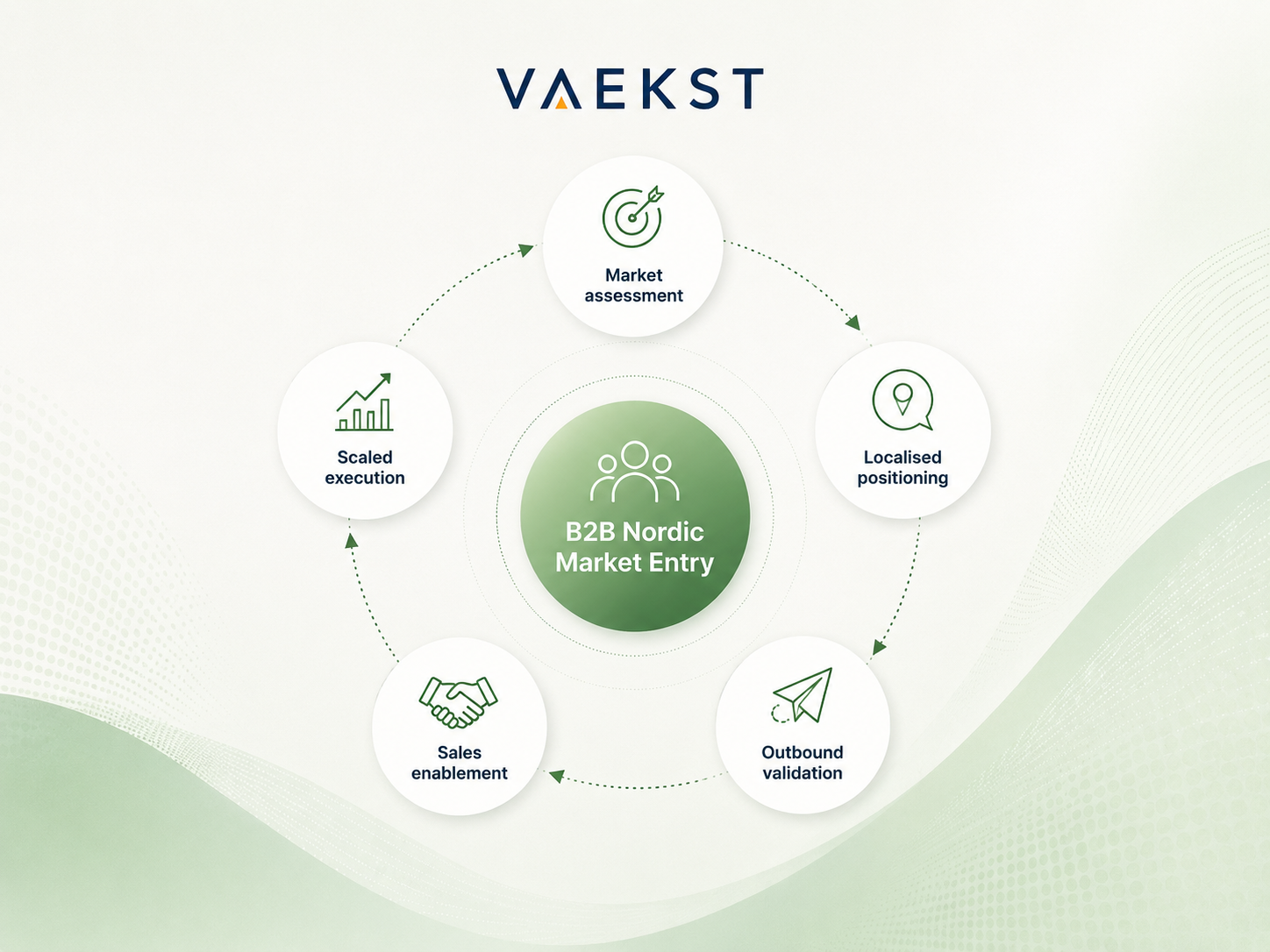
A practical b2b nordic market entry model
A commercially useful Nordic market entry model should move through five stages.
1. Market assessment: Identify the best-fit Nordic market based on ICP density, trigger events, competitive context and accessibility.
2. Localised positioning: Translate your value proposition into market-specific pain points, proof and commercial outcomes.
3. Outbound validation: Test messaging, segments and stakeholder hypotheses through structured outreach.
4. Sales enablement: Equip the team with qualification frameworks, objection handling, buyer enablement assets and CRM discipline.
5. Scaled execution: Increase activity across proven segments and use ABM, social selling and marketing to support priority accounts.
Expanding with local relevance and commercial discipline
The Nordics reward preparation. Buyers will engage with new vendors when the outreach is relevant, the business case is clear and the sales process respects how decisions are made locally. For companies entering the region, the biggest shift is moving from international messaging to Nordic commercial execution. That means sharper market prioritisation, localised sales conversations, early outbound validation and enablement that helps buyers build internal confidence.
VAEKST helps B2B companies enter and scale across the Nordics through go-to-market strategy, outbound sales, account-based marketing and sales enablement. With 300M DKK in closed sales deals facilitated and 150+ brand collaborations, we help companies turn Nordic market interest into measurable pipeline.
Explore how VAEKST supports B2B companies with Nordic Go-To-Market execution.
Let's have a chat about your GTM
Have a virtual cup of coffee with one of our sales experts to explore collaboration opportunities.