B2B decision making process: Influence the stakeholders
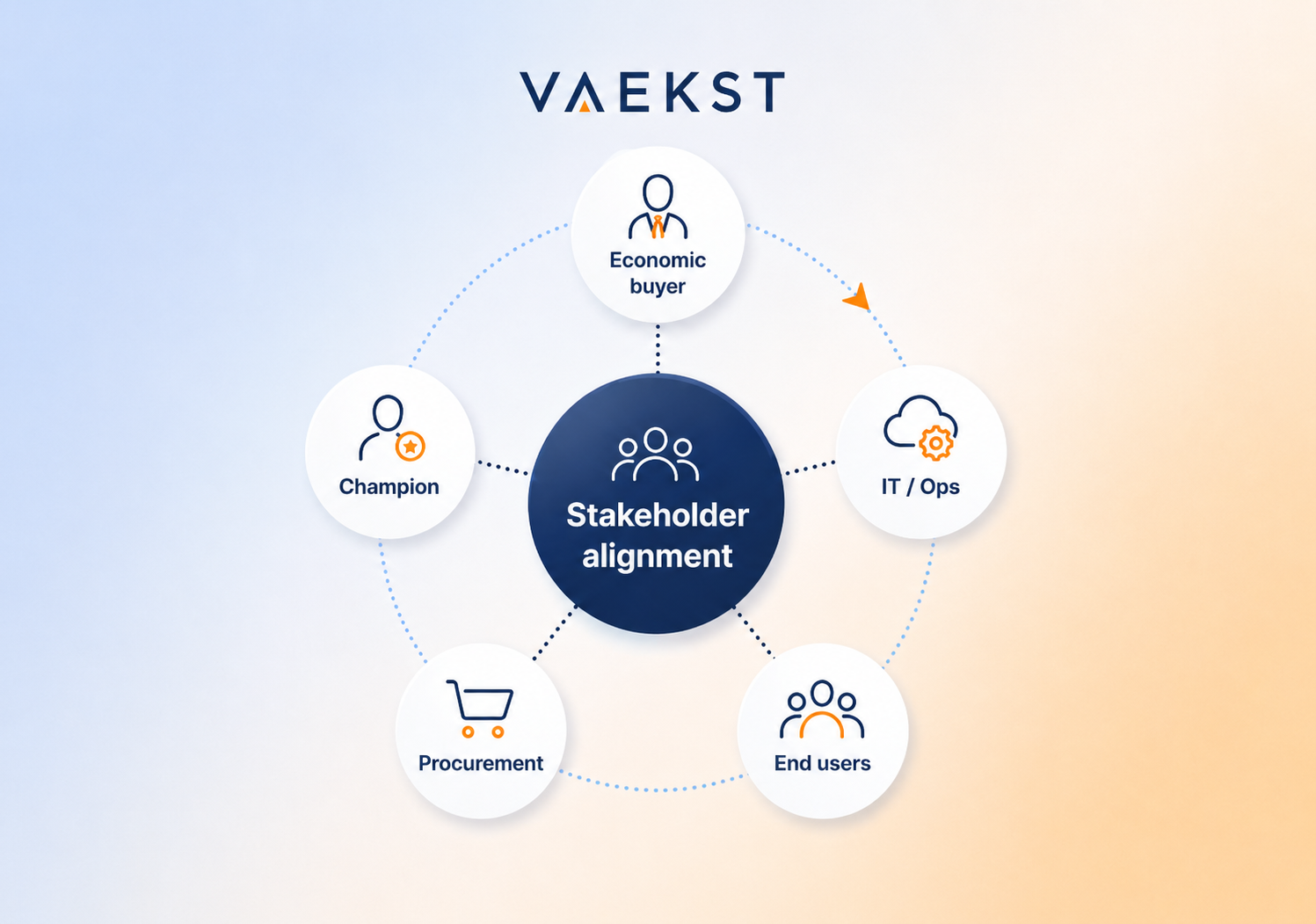
Complex B2B deals rarely move forward because one person likes the solution. They progress when enough people inside the buying organisation understand the commercial case, feel comfortable with the risk and can justify the decision internally.
That makes the b2b decision making process an important part of sales strategy. A sales team can have a credible value proposition and an engaged contact, yet still lose momentum when procurement, finance, IT, management or end users enter the process with different priorities.
The commercial challenge is therefore to understand how buying dynamics develop across the account and give each stakeholder the information they need to support progress. In this article, we examine the main stakeholder roles, how influence shifts during the buying process, where deals typically lose momentum and how sales and marketing teams can help buying groups reach a decision.
Why the b2b decision making process can be difficult
As deal value and organisational impact increase, more people tend to become involved. Each stakeholder evaluates the purchase through a different lens. A commercial leader may focus on revenue impact and strategic relevance, while finance looks more closely at the business case and financial exposure. IT and operations are likely to assess integration, implementation and internal workload, whereas end users will often judge the solution by how well it fits into their daily work.
These perspectives are reasonable individually. The difficulty appears when they compete for attention inside the same buying process. That can create several points of friction:
- An enthusiastic champion creates access but lacks the authority to secure the deal.
- A senior sponsor supports the commercial case while operational stakeholders remain unconvinced.
- Procurement introduces new requirements late in the process that the sales team has not addressed.
The earlier these dynamics become visible, the easier it is to manage the buying process proactively. Good opportunity management requires visibility into these dynamics before they become obstacles. Qualification frameworks such as MEDDICC help because they force sales teams to map decision criteria, decision processes, economic buyers and internal champions rather than relying on engagement levels alone. This stakeholder view should also influence your Go-To-Market strategy. ICP definition becomes more commercially useful when it covers the buying group around an opportunity as well as the companies you want to reach.
Map the people who shape the decision
Stakeholder mapping should begin early enough to guide the sales process. Job titles provide a starting point, although they rarely tell you how much influence someone actually has. The Head of Sales may own the initiative while the COO controls implementation capacity. A procurement manager may enter late but have substantial influence over terms and vendor approval.
A practical stakeholder map can include five roles:
- Economic buyer: controls or approves the commercial investment
- Champion: benefits from the change and actively helps the deal move internally
- Technical or operational evaluator: assesses implementation, security, compatibility or delivery requirements
- End-user stakeholder: evaluates how the solution affects workflows and adoption
- Potential blocker: has enough influence to slow or stop the decision
The same person can occupy more than one role. Smaller businesses may concentrate several roles with one executive, while enterprise accounts can involve committees across functions and markets. Sales teams should therefore ask questions that reveal influence rather than simply collect names such as:
- Who needs to approve the initiative?
- Which teams will be affected during implementation?
- Who has challenged similar investments before?
- What happens internally after the next meeting?
Influence the economic buyer through commercial relevance
Economic buyers usually need confidence that the initiative deserves resources relative to competing priorities. Feature detail carries limited weight at this level unless it connects directly to business performance. The conversation should focus therefore on the commercial gap between the current situation and the desired outcome, including what happens if the organisation continues with the present approach.
Gap Selling is useful here because it frames value around the distance between the current and future state. The clearer that distance becomes, the easier it is for an executive stakeholder to evaluate whether change deserves attention. Salespeople can support this conversation by quantifying operational impact, linking the initiative to existing strategic priorities and agreeing how success will be measured.
For example, a commercial leadership team considering a new sales initiative may care about pipeline coverage, conversion rates, market penetration and sales productivity. The economic case becomes easier to evaluate when the proposed solution connects directly to those metrics. This is also where B2B Marketing can support sales. Executive-facing reports, market insights and business cases give senior stakeholders material they can use when discussing the initiative internally.
Help champions sell the decision internally
Champions are often the most important source of momentum because they continue the sales conversation when the supplier is outside the room. However, internal advocacy requires more than enthusiasm. The champion needs to explain the problem, defend the proposed approach and respond to questions from colleagues who have had less exposure to the sales process.
That makes buyer enablement a central part of stakeholder influence.Instead of relying on the champion to repeat a full sales presentation, give them material that travels well internally. A concise business case, stakeholder-specific summary, implementation overview or comparison of current and future processes can help them build internal alignment.
The Jolt Effect is relevant here because buyer hesitation often increases when people feel uncertain about making the wrong decision. Providing clearer decision support reduces some of the ambiguity surrounding the purchase and gives the buying group more confidence in how to proceed. Sales teams should also understand how much influence the champion genuinely has. Useful questions include:
- Who have you discussed this with internally?
- What concerns have come up so far?
- Which approval steps remain?
- What information would help with the next internal conversation?
Reduce friction for technical and operational stakeholders
Technical and operational stakeholders frequently enter the process after the commercial value has already been established. Their concerns can therefore look like resistance when they are often evaluating a different category of risk. They may need clarity around integration requirements, implementation workload, governance, data flows or internal ownership.
Sales teams create unnecessary friction when they treat these questions as secondary details. If an operational stakeholder believes implementation will create excessive workload, the commercial upside may carry little influence over their recommendation. Bring these stakeholders into the process before final approval whenever possible. Give them access to relevant experts, document dependencies clearly and make the implementation path visible.
A well-designed Sales Enablement process helps here because sellers need consistent access to the right proof points, technical material and stakeholder-specific messaging throughout the deal.
Use account-based marketing to build wider consensus
Many opportunities depend on one active contact for too long. That creates risk if the contact loses influence, changes role or cannot build internal support. Account-Based Marketing helps create familiarity across the wider buying group before every stakeholder enters a sales conversation. Senior leaders may respond to commercial outcomes, while operational stakeholders are more likely to engage with implementation guidance, customer examples or process insights.
Sales and marketing should coordinate this activity closely. Engagement from new stakeholders can reveal that internal discussions are expanding and help the sales team identify where influence is shifting. Captured in the CRM, these signals provide useful context for opportunity reviews and deal progression.
Adapt your message as influence shifts
Buying dynamics change throughout the deal. The stakeholder who initiates the project may have the greatest influence during discovery, while finance or procurement becomes more important closer to approval. Technical teams may enter later and become decisive because implementation depends on their support. A static stakeholder map therefore becomes outdated quickly. Opportunity reviews should track how influence has changed since the previous stage by asking:
- Which new stakeholders have entered the process?
- Has anyone become less engaged or influential?
- Which concerns remain unresolved?
- What internal decision needs to happen next?
This also improves forecasting. A late-stage opportunity with one engaged contact and no access to the economic buyer should be evaluated differently from a deal where the wider buying group has aligned around the business case. CRM stages alone cannot provide that context. Commercial teams need pipeline data alongside a qualitative view of how the buying process is developing inside the account.
Measure buying progress rather than activity alone
Meetings, email replies and document views show engagement, although they reveal little about whether the organisation is becoming more capable of making a decision. Useful buying-progress indicators include:
- Access to the economic buyer
- Number of relevant stakeholders actively involved
- Agreement on decision criteria
- Identified approval and procurement steps
- Confirmed implementation ownership
These indicators help sales teams distinguish genuine progression from opportunities that remain active without moving materially closer to a decision. They also make coaching more precise. Instead of telling a salesperson to follow up again, a manager can identify the missing stakeholder or unresolved decision criterion that needs attention.
Make the buying process easier to navigate
Understanding the b2b decision making process helps sales teams manage more than individual conversations. It gives them a clearer view of how decisions form inside the account. The commercial opportunity lies in helping stakeholders reach internal alignment with less uncertainty. That requires early stakeholder mapping, relevant communication and consistent support as new people enter the process.
For sales leaders, the practical test is simple: look at the largest opportunities in your pipeline and assess whether your team understands who influences the decision, what each stakeholder needs and how the account will reach approval.
Explore how VAEKST helps B2B companies improve commercial execution through Sales Enablement and structured Go-To-Market programmes.
Let's have a chat about your GTM
Have a virtual cup of coffee with one of our sales experts to explore collaboration opportunities.