B2B customer journey mapping from awareness to advocacy
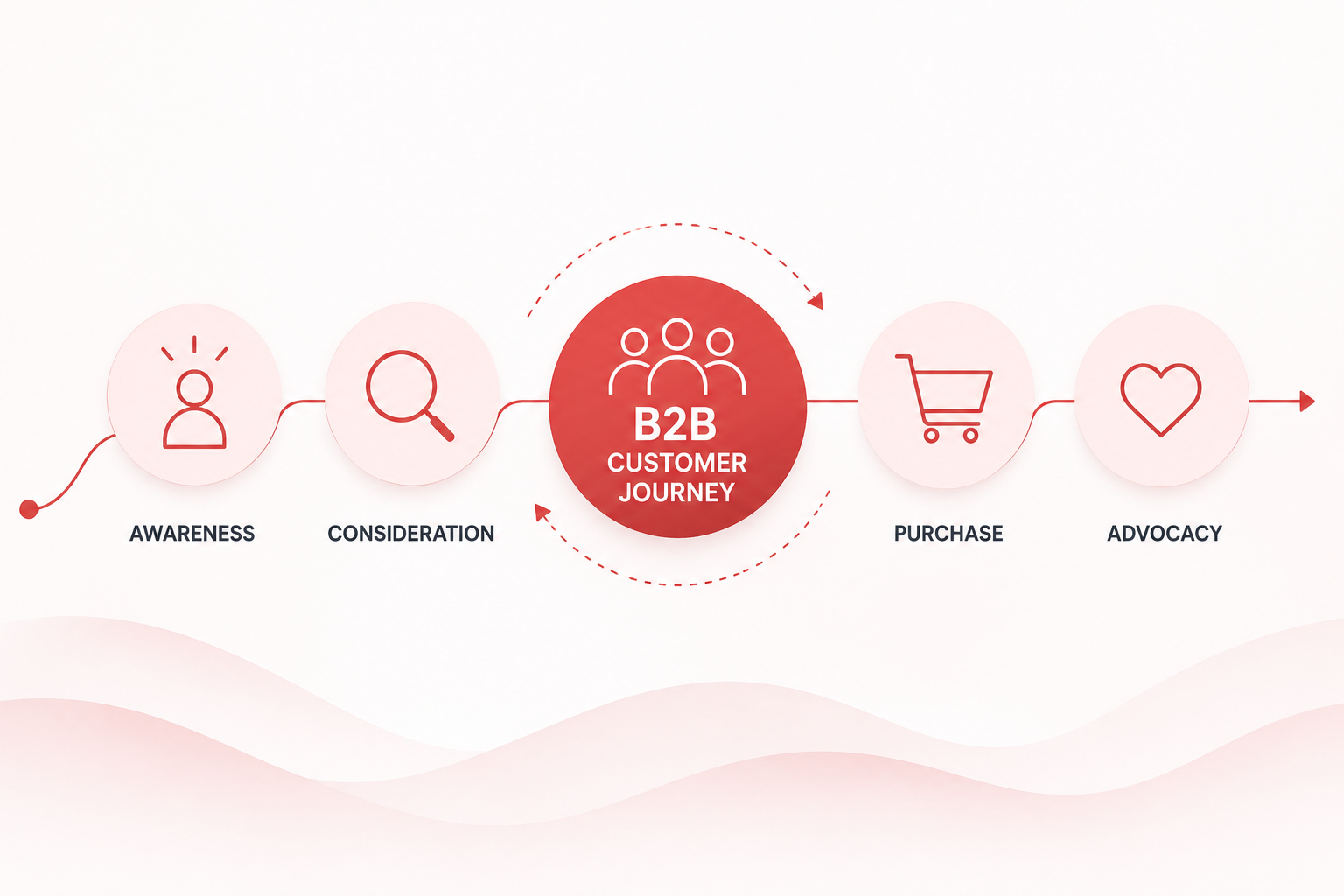
B2B buying journeys rarely follow a clean sequence from first touch to signed contract. Buyers move between research, internal discussions, supplier conversations and validation as new stakeholders enter the process and priorities change.
This article explains how B2B customer journey mapping can help commercial teams understand that movement from awareness through purchase, adoption and advocacy. The purpose is to identify what buyers need at each stage, where commercial friction appears and how marketing, sales and customer teams can support progress more consistently.
Why B2B customer journey mapping matters
A traditional funnel shows how prospects move through your commercial process. Customer journey mapping adds the buyer perspective by showing what happens around those stages: which events create demand, what information buyers need and where uncertainty slows the decision.
That distinction matters in complex B2B sales because the CRM only captures part of the journey. A prospect may spend weeks researching a category before becoming known to your business, while several stakeholders can form opinions about potential suppliers before anyone speaks with sales. A useful journey map makes four areas visible:
- What triggers the buyer to start exploring a problem or opportunity
- Which stakeholders influence the decision at different stages
- What information or proof buyers need to keep moving
- Where friction causes momentum to slow or disappear
Effective journey mapping therefore connects observable commercial activity with buyer behaviour. It gives teams a shared view of how demand develops and helps identify whether the right content and conversations are available when buyers need them. This is particularly valuable when B2B Marketing and sales operate across several channels. Without a shared journey, both teams can generate activity while still leaving important buying needs unsupported.
Map the buying reality across accounts
Journey maps become more useful when they reflect how buying decisions actually happen within an account. In many B2B purchases, the person who first identifies the problem will not control the budget, and the final decision may involve stakeholders who have had little direct contact with your company.
Gartner describes B2B purchasing through a series of buying jobs, including problem identification, solution exploration and supplier selection. Buyers often revisit these jobs as they build internal consensus and gather new information.A useful journey map should therefore document more than channels. It should capture the buyer's objective at each stage, the questions creating friction, the stakeholders involved and the evidence required to move forward.
For organisations pursuing selected high-value accounts, Account-Based Marketing can extend this approach further by mapping journeys at account level. The commercial team can then coordinate activity around the people involved in a specific buying process instead of treating every individual interaction as an isolated lead.
Awareness begins with a commercial trigger
Awareness starts when a buyer recognises that something in the current situation deserves attention. These triggers shape how the buyer defines the problem and what they look for next. Common commercial triggers include:
- Changing market conditions that put pressure on current performance
- Internal data showing declining conversion, efficiency or growth
- A new strategic priority, such as entering a market or launching a service
- Organisational changes that create new requirements or expose existing gaps
Your journey map should identify which triggers are most relevant to your buyers because they influence the initial frame of reference. A business reacting to declining conversion will search differently from a company preparing to enter a new market, even if both eventually evaluate the same service.
At this stage, marketing should help buyers understand the problem and its commercial implications before asking for a high level of commitment. Relevant content can include benchmark data, market insight, diagnostic tools and a clear point of view that helps the buyer interpret what is happening. The mapping exercise should also show how buyers first encounter your company, for example through search, LinkedIn, events, referrals or outbound activity. The importance of each channel will vary depending on the buying context and the maturity of demand.
Consideration is shaped by internal consensus
Once buyers start exploring potential approaches, the journey becomes more complex. They need to compare options while building internal agreement around priorities, requirements and acceptable trade-offs. Customer journey mapping should make that internal decision process visible by showing:
- Which stakeholders enter the buying process at each stage
- What each stakeholder needs to understand before supporting the decision
- Which evaluation criteria influence supplier selection
- Where disagreement, missing information or uncertainty slows progress
A commercial sponsor may focus on revenue impact while a technical stakeholder examines implementation requirements. Procurement may enter later with another set of criteria, which means the buying group rarely evaluates a solution from one shared perspective. Content and sales conversations should help stakeholders reach a common understanding of the problem and proposed change. Case studies, solution comparisons, commercial workshops and customer evidence can support this when they answer the specific questions different stakeholders bring into the process.
Challenger Sales is particularly relevant here. Insight can influence how buyers define the problem before supplier selection becomes purely comparative, giving commercial teams an opportunity to shape decision criteria around outcomes that matter.
Decision mapping should reduce uncertainty
Late-stage opportunities often contain more uncertainty than the CRM suggests. A deal may have an identified budget, clear requirements and positive stakeholder feedback while the buyer still feels uncomfortable committing to change. Research presented in The JOLT Effect highlights the commercial impact of customer indecision in complex sales. Buyers can hesitate because they fear choosing incorrectly, particularly when several alternatives appear credible and the personal consequences of a poor decision feel significant.
Journey mapping can make these concerns visible. Sales teams should document which questions tend to appear before approval, which stakeholders need additional reassurance and which forms of proof help the buying group move forward. This can also improve qualification. MEDDICC elements such as decision criteria, decision process and economic buyer become easier to interpret when they sit within a broader view of the customer's journey rather than appearing only as CRM fields.
Adoption determines whether the promised value becomes visible
The customer journey continues after the contract is signed. Implementation and early adoption determine whether the business case developed during the sales process begins to translate into visible results.
A useful journey map should make the post-sale experience visible by showing:
- How expectations are transferred from sales into delivery and customer management
- Where customers need additional guidance during onboarding
- Which behaviours indicate that adoption is progressing as intended
- Where recurring questions or delays reveal gaps in the earlier sales process
When context disappears during the handover, customers can find themselves repeating information or discovering that the commercial conversation created expectations that onboarding does not address clearly. This stage also gives commercial teams valuable feedback. Recurring onboarding questions can reveal gaps in sales messaging, while slow adoption can indicate that decision-makers and end users were insufficiently aligned during the buying process.
CRM structure matters here because journey data should continue beyond closed-won. A well-configured HubSpot setup can connect acquisition sources, sales activity, customer information and lifecycle data so teams can analyse the journey with greater consistency.
Advocacy turns customer value into market proof
Advocacy is attainable when customers can see meaningful value and feel confident associating their name with your company. This stage deserves a defined place in the journey because existing customers influence future demand through references, recommendations and market credibility.
Customer teams should map the moments when advocacy requests feel natural. A successful implementation milestone, measurable business result or positive executive review can create a relevant opportunity to discuss a case study, reference call or referral. Commercially, advocacy also closes the loop between post-sale experience and new pipeline creation. Reference willingness, customer stories, expansion opportunities and referral-sourced deals can reveal whether the customer experience is creating value beyond retention alone.
The insight gathered here should feed back into earlier stages. The language customers use to describe outcomes often improves marketing messages and gives sales teams more credible examples for future conversations.
How to run a B2B customer journey mapping process
Start with evidence from the customer journey you already have. CRM data can show conversion patterns and sales-cycle behaviour, while customer interviews reveal motivations and friction that systems rarely capture. Sales and customer teams can add context from conversations that never become structured data. For each stage, document four areas:
- The buyer's objective and the event that created momentum
- The stakeholders involved and how their role changes
- The questions, concerns and information requirements that affect progress
- The commercial interactions and content supporting the buying process
Once the map is drafted, compare it with actual opportunities. Look for points where deals repeatedly slow down, stakeholders enter unexpectedly or prospects request information that your process does not provide early enough. The result should influence execution. Journey mapping has limited value as a static workshop output; its commercial contribution comes from changing campaigns, content, sales conversations, handovers and measurement based on what the map reveals.
Making B2B customer journey mapping actionable
Effective B2B customer journey mapping helps commercial teams see the buying process from first awareness through customer advocacy.
- Map buyer objectives and friction alongside your internal sales stages
- Include the wider buying group as stakeholders enter and influence the decision
- Use journey insight to improve content, sales conversations, onboarding and measurement
- Connect each stage with conversion, revenue and customer outcomes
- Update the map as customer behaviour and commercial evidence change
For companies looking to connect journey insight with commercial execution, explore how VAEKST supports B2B companies across marketing, sales and Go-To-Market.
Let's have a chat about your GTM
Have a virtual cup of coffee with one of our sales experts to explore collaboration opportunities.