Data-driven sales forecasting for software companies
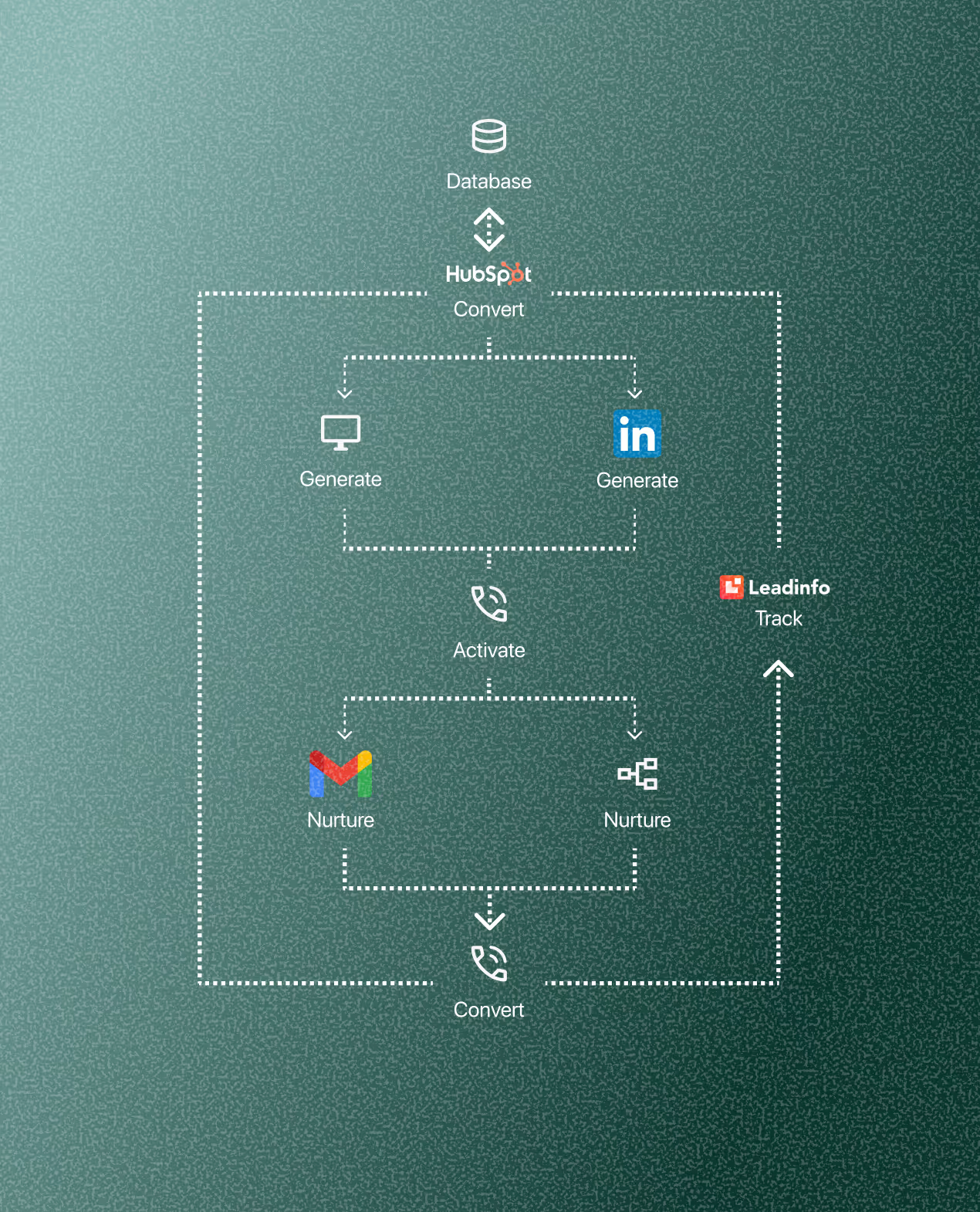
Forecasting gets harder when software companies grow across multiple revenue motions. New markets and expansion revenue can pull the forecast in different directions, especially when outbound, product-led and partner-led opportunities are measured by the same pipeline logic. Better spreadsheet discipline helps, but it rarely solves the real issue: whether the forecast reflects actual buyer momentum or just internal pipeline assumptions.
This is important since forecasting is rarely just a reporting task. It shapes hiring plans, market-entry decisions, board communication and where revenue teams spend their next commercial hour. When the forecast is built on weak signals, leadership may still see a confident number, but miss the risks behind it. In this article, we look at how software companies can use CRM data, predictive analytics, buyer signals and ICP-specific pipeline visibility to build forecasts that support better revenue decisions.
Why sales forecasting for software companies loses accuracy
Software companies usually have more sales data than they use well. CRM activity, email engagement, website visits, demo requests, product usage, intent signals, deal notes, stage movements, renewal dates and customer success input all contain forecasting value. The problem is that this data often sits across disconnected systems or enters the forecast through subjective interpretation.
A forecast can easily inherit the bias of whoever reads the pipeline. Sales managers may lean on rep confidence, founders may be drawn to deal size, and revenue leaders may rely too heavily on stage probability. These inputs all have value, but they become risky when they are not tested against historical conversion behaviour. Common forecasting problems include:
- Stage probabilities that have not been updated since the CRM was implemented
- Pipeline values that do not reflect deal quality or sales cycle maturity
- Forecast categories that mean different things across reps, regions or business units
- Missing data on buyer roles, decision criteria, urgency and next steps
For SaaS and software companies scaling across the Nordics, these issues often appear when the company moves from founder-led selling into a more structured Go-To-Market strategy.
The role of predictive analytics in sales forecasting
Predictive analytics improves forecasting by identifying patterns that humans often miss or overweight. Instead of relying only on rep judgement, predictive models compare active opportunities with historical deal behaviour. This includes conversion rates by segment, stage duration, source quality, stakeholder coverage, engagement frequency, CRM completeness and product usage patterns.
For software companies, this is valuable because deal quality can vary significantly across ICPs. An enterprise opportunity in a regulated industry may take longer to close but generate stronger retention. A mid-market opportunity may move faster but require tighter qualification. In a Nordic expansion case, the decisive signal may be whether the sales team has mapped the buying committee properly, especially when the market is less mature than the company’s domestic base. Predictive analytics helps revenue teams ask better forecasting questions:
- Do active opportunities resemble previously won deals?
- Are late-stage deals stalling beyond normal stage duration?
- Which segments consistently convert above forecast assumptions?
- Does the lead source create pipeline that closes, or mainly pipeline that enters the CRM?
Build the forecasting model around revenue signals
A reliable sales forecast depends on the quality of the data behind it. Many software companies track the standard CRM fields: deal value, expected close date, stage, owner and source. These fields are necessary, but they do not explain enough on their own. Deal value, close date and stage describe the opportunity at a surface level. What they often miss is whether the buyer is showing enough momentum to convert. A stronger forecasting model should combine four types of signals.
1. Commercial fit
This shows whether the opportunity matches your ICP. Relevant fields include company size, industry, market, tech stack, buying trigger and estimated revenue potential. A high deal value can look attractive, but if the account sits outside the ICP, the forecast should treat it with more caution.
2. Buyer engagement
This shows whether the prospect is actively moving towards a decision. Useful signals include meeting attendance, stakeholder responsiveness, email engagement, product usage, content consumption and whether senior decision-makers are involved. In software sales, silence from the economic buyer often matters more than enthusiasm from an operational champion.
3. Sales process quality
This shows whether the opportunity is being managed with enough control. Track stage age, next step quality, decision criteria, mutual action plan status, MEDDICC completeness and close date movement. These signals help managers separate real momentum from deals that are simply progressing in the CRM.
4. Historical conversion behaviour
This shows how similar opportunities have performed before. Look at win rates by segment, source, market, company size, sales motion and use case. If enterprise opportunities from one market consistently take longer to close, that should affect the forecast. If outbound-sourced mid-market deals from a specific ICP convert faster than inbound demo requests, that should influence resource allocation.
When these signals are connected through HubSpot optimisation or another CRM system, forecasting becomes part of daily commercial execution. Sales leaders no longer have to wait for the forecast meeting to discover risk. The system shows where pipeline is strong, where assumptions are weak and where coaching is needed.
Forecasting by ICP rather than total pipeline
Total pipeline can create false comfort. A software company may have strong aggregate pipeline coverage while still being underexposed in the segments most likely to close. This is why ICP-specific forecasting matters. A forecast should show where revenue is expected to come from, which segments support that expectation and whether the current pipeline mix matches the company’s Go-To-Market strategy.
A B2B SaaS company entering Sweden may need one forecast logic for local mid-market accounts and another for Nordic enterprise opportunities. An existing customer expansion motion should also be reviewed separately, because it often carries different conversion signals, stakeholder dynamics and sales cycle expectations. Forecasting by ICP allows leadership to compare pipeline quality across:
- Segment and company size
- Market and region
- Use case and buying trigger
- Acquisition channel and sales motion
This gives commercial teams a more accurate view of where to allocate outbound sales, account-based marketing and sales enablement resources. It also helps prevent the common mistake of treating all pipeline as equally valuable.
How sales enablement improves forecast accuracy
Forecasting problems are often enablement problems in disguise. If reps define qualification differently, update CRM fields inconsistently or move deals through stages without clear exit criteria, predictive analytics will amplify bad inputs. The model can only learn from the data it receives. This makes sales enablement central to better forecasting. Reps need clear definitions for qualified pipeline, stage progression, next steps, decision process and close probability. Managers need dashboards that show both forecast numbers and the behaviours behind them.
Practical enablement improvements include:
- Clear stage exit criteria linked to buyer evidence
- Mandatory fields for decision process, urgency and stakeholder coverage
- Forecast review routines focused on deal risk, not rep reassurance
- Coaching based on conversion data by segment, source and sales motion
Frameworks such as MEDDICC can improve forecasting because they force the sales team to capture evidence around metrics, economic buyer, decision criteria and decision process. For software companies selling complex solutions, this is particularly useful because late-stage confidence often depends on whether the buying process is genuinely understood.
The forecasting metrics software companies should track
A better forecast requires more than one headline number. Revenue teams should build a forecasting dashboard that connects pipeline movement and deal conversion. This makes it easier to spot whether forecast risk comes from insufficient demand, weak qualification, slow sales velocity or poor late-stage conversion. Useful metrics include:
- Pipeline coverage by ICP and forecast period
- Stage conversion by source, segment and market
- Average stage duration for won and lost opportunities
- Close date movement by rep, team and deal type
These metrics help leadership identify where forecasting accuracy breaks down. Repeated close-date movement in one segment may point to unrealistic sales cycle assumptions. A sharp conversion drop after demo often indicates weak discovery or qualification. When outbound-sourced opportunities convert better than inbound within a specific ICP, the Go-To-Market model may need rebalancing.
What stronger forecasting changes commercially
A sharper forecast gives software leaders more than a cleaner revenue number. It shows where growth is coming from, where risk is building and which commercial decisions need attention before the quarter is already under pressure.
Sales forecasting for software companies becomes more valuable when ICP strategy, CRM structure, buyer behaviour and sales execution are connected. The best software companies use forecasting to answer commercially important questions such as:
- Which ICPs create the most reliable revenue?
- Which sales motions generate pipeline that actually closes?
- Where are close dates moving because of genuine complexity?
- Which CRM gaps are weakening leadership visibility?
Predictive analytics can improve forecast accuracy, but only when the underlying data is trustworthy. Inconsistent stage usage, missing buyer signals and broad ICP definitions will still make the forecast fragile. For software companies entering or scaling in the Nordics, this matters. Better forecasting shows what is working and where revenue risk sits, so commercial teams can act before the quarter is already under pressure.
Explore how VAEKST helps software companies strengthen sales forecasting through HubSpot optimisation, Sales Enablement and Go-To-Market execution.
Let's have a chat about your GTM
Have a virtual cup of coffee with one of our sales experts to explore collaboration opportunities.