A practical revenue operations framework for B2B SaaS
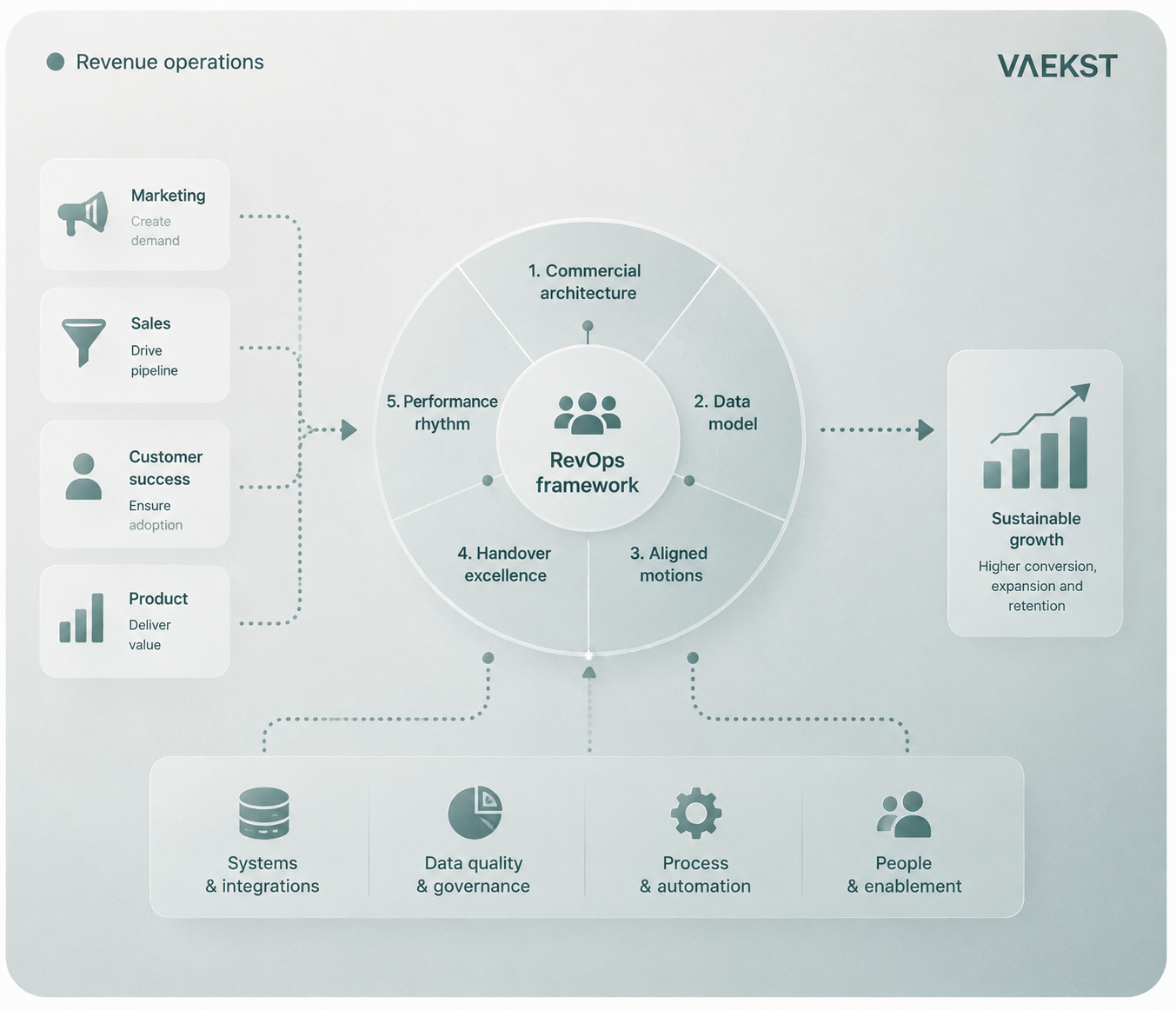
As B2B SaaS companies scale, growth often becomes harder to coordinate across the revenue organisation. Marketing creates demand, sales works the active pipeline, customer success protects retention, and leadership needs clearer forecasting. Each function may perform well on its own, while the wider commercial system still feels fragmented.
This is where a practical revenue operations framework becomes valuable. It connects strategy, systems, data, process and team behaviour, so commercial decisions become easier to make and easier to act on. For SaaS companies, where recurring revenue depends on both acquisition and retention, that alignment directly affects conversion, expansion and forecast confidence.
In this article, we outline a practical revenue operations framework for aligning marketing, sales, customer success and leadership in B2B SaaS.
Why revenue operations breaks in scaling SaaS teams
Early-stage SaaS companies often grow through speed. The team is close to the customer, feedback travels quickly and commercial decisions happen in the same room. As headcount increases, that informal alignment starts to weaken. Sales wants a more qualified pipeline, while marketing needs clearer visibility into what actually converts. Customer success depends on better expectations before handover, finance needs greater forecast accuracy, and leadership wants to keep growth under control without slowing the commercial engine. The problem often becomes visible in small operational frictions:
- Different teams define a qualified opportunity differently
- CRM data reflects activity, but not buying reality
- Handover notes miss critical context
- Marketing campaigns target accounts sales does not prioritise
- Customer success discovers misalignment after the deal is closed
None of these issues look dramatic in isolation. Together, they slow down growth because teams start optimising locally instead of working from one commercial operating model. A practical revenue operations framework should reduce this friction by giving every revenue team the same language, data structure and execution rhythm.
The alignment-first revenue operations framework
Effective RevOps starts with the commercial decisions the business needs to make, such as:
- where to focus market effort
- how to define a good-fit customer
- what signals indicate buying intent
- which handovers matter before activation
- and which metrics leadership should trust when making hiring, budget and GTM decisions.
For B2B SaaS companies, a practical revenue operations framework should be built around the following five connected areas.
1. Define the commercial architecture
Revenue operations starts with commercial architecture. This means clarifying how the company creates, converts and expands revenue. For a B2B SaaS company, this typically includes:
- ICP and account segmentation
- Funnel and lifecycle stages
- Lead and opportunity qualification criteria
- Ownership across marketing, sales and customer success
The core work is agreeing on the rules that shape daily execution, so teams know how segments, stages, ownership and handovers should work in practice. For a SaaS company selling to mid-market finance teams, this could mean accepting leads based on role relevance and account fit, qualifying opportunities through business pain and stakeholder ownership, and documenting use case, success criteria and key risks before customer handover.
When these definitions are vague, teams interpret them differently. When they are specific, the CRM becomes a shared operating system rather than a reporting tool that people update retrospectively.
2. Build one revenue data model
Revenue teams struggle to align when they do not trust the data in front of them. SaaS companies often have commercial signals across website visits, campaign engagement, outbound activity, demo conversion, product usage, renewal risk and expansion potential, but those signals lose value when they sit in separate systems or inconsistent fields.
A revenue operations framework should turn this into one usable data model. This means deciding which data points matter, where they live and how they influence decisions. HubSpot, Salesforce or another CRM should hold the commercial truth, but the value comes from disciplined design rather than the platform itself. Key questions include:
- Which fields are mandatory at each lifecycle stage?
- Which source data should be trusted when attribution conflicts appear?
- Which activities show genuine buying intent?
- Which customer success signals should inform expansion or churn risk?
- Which dashboards are used for decisions, not just reporting?
Clean data does not mean perfect data. It means commercially useful data. A sales leader should be able to see where pipeline quality is improving. Marketing should be able to understand which campaigns create revenue, not only engagement. Customer success should see what was promised during the sales process before onboarding begins.
This is where HubSpot optimisation can become a growth lever. When the CRM reflects the real customer journey, revenue teams spend less time reconciling numbers and more time improving performance.
3. Align teams around shared revenue motions
Team alignment becomes harder when every function works from its own calendar, targets and interpretation of performance. A revenue operations framework should create shared revenue motions across acquisition, conversion, onboarding and expansion. Functional ownership still matters, but RevOps clarifies how each team depends on the others across acquisition, conversion, onboarding and expansion.
For example, an account-based marketing motion only works if sales and marketing agree on target accounts, buying committee roles, messaging themes and follow-up timing. Outbound only scales if CRM hygiene, sequencing, call feedback and qualification rules reinforce each other. Customer expansion becomes more predictable when customer success and sales agree on the signals that indicate expansion potential, as well as the right commercial timing. SaaS teams should create recurring forums for:
- Campaign and pipeline alignment
- Funnel conversion review
- Handover quality review
- Forecast and deal inspection
- Customer health and expansion planning
4. Improve handovers across the customer journey
Revenue leaks often appear at handover points, where leads, customers, expansion signals and strategic priorities move between teams. Each transition creates risk because buyer motivation, internal politics, promised outcomes and hesitation points can lose clarity along the way. A practical revenue operations framework should define what context must be transferred, when it happens and who owns handover quality.
For B2B SaaS, sales-to-customer-success handover is especially important. If customer success receives a closed-won deal without clear context, onboarding starts with discovery that should already have happened. This weakens trust and delays time to value. A good handover should include the:
- Business problem the customer wants to solve
- Stakeholders involved in the decision
- Success criteria agreed during sales
- Implementation risks or concerns raised before close
- Expansion potential
5. Create a performance rhythm leadership can trust
RevOps should make performance visible without overwhelming the organisation with dashboards. The goal is to create a rhythm where leadership can see performance clearly and understand what needs to change. For B2B SaaS, that requires a tighter connection between pipeline performance, conversion quality and customer outcomes. Useful metrics may include:
- Pipeline coverage by segment
- Stage conversion by source
- Sales cycle length by ICP fit
- Forecast accuracy by team
- Churn and expansion by acquisition channel
The commercial value comes from interpretation. A high volume of demos may look positive until conversion shows that many sit outside the ICP. New business growth can also hide future churn if sales expectations are misaligned with product capability, while pipeline value may create false confidence when late-stage opportunities lack senior stakeholder engagement. Revenue operations helps leadership spot these patterns early, allocate resources more precisely and fix process issues before they become revenue problems.
What to avoid when scaling RevOps
Many SaaS companies make RevOps too technical too early. They invest in workflows, dashboards and automation before agreeing on the commercial logic behind them. That creates complexity without clarity. A few warning signs usually appear:
- Teams debate reporting definitions more than customer behaviour
- CRM fields exist because someone once requested them
- Dashboards show activity, but not decision-quality insight
- Automation increases speed, but also increases poor-fit handovers
- Forecast meetings focus on opinions rather than evidence
The better approach is to start with the revenue decisions the business needs to make, then design systems and processes around those decisions.
Building a revenue operations framework that aligns teams
A practical revenue operations framework helps B2B SaaS companies scale with greater control. It creates shared definitions, cleaner data, better handovers and a clearer performance rhythm across the revenue organisation. Alignment is the practical starting point. It should operate as a principle built into CRM structure, funnel governance, campaign execution, sales process and customer success collaboration.
When revenue teams work from the same commercial model, growth becomes easier to manage. Teams make decisions faster, leadership trusts the numbers and the customer journey becomes more consistent from first touch to renewal.
Explore how VAEKST helps B2B companies improve sales enablement and HubSpot optimisation.
Let's have a chat about your GTM
Have a virtual cup of coffee with one of our sales experts to explore collaboration opportunities.