Revenue Intelligence: Turning Sales Data Into Predictable Growth
.avif)
Revenue Intelligence: Turning Sales Data Into Predictable Growth
In today’s B2B landscape, the most successful companies are those that master the skill of turning data into predictable revenue.
That’s the essence of revenue intelligence and companies need a holistic framework that integrates sales, marketing, and Revenue Operations (RevOps) into one growth system.
At VAEKST, we assist Nordic Professional Services and IT companies with building such data-driven systems, uniting insight and execution to scale their sales.
What Is Revenue Intelligence and Why It Spans the Entire GTM Strategy
Revenue intelligence is the process of collecting, analysing and activating insights across your Go-To-Market (GTM) motion.
It touches every growth channel from outbound calls and LinkedIn campaigns to website conversions and ad impressions.
When sales, marketing and RevOps work in silos, insights are lost and growth becomes unpredictable. But when growth activities are unified under one revenue intelligence framework, every team works toward the same goal of creating predictable revenue growth.
Here, marketing attracts, educates and re-engages the right accounts, while sales ensures a consistent, predictable lead flow through continuous insight-led outreach that converts intent to action at the right time.
This alignment transforms data-driven revenue growth from theory into execution, directly influencing the bottomline of your company.
Step 1 - Validate Your Growth Model Before You Optimise Metrics
Before optimising outreach or pipeline metrics, validate that your model can scale sustainably.
Start with your Growth Multiple, which reveals how efficiently your sales investments pay back, becoming the most important metric for your business:
- Customer Lifetime Value (CLV) = Gross Profit ÷ Number of Customers
- Customer Acquisition Cost (CAC) = Sales & Marketing Spend ÷ New Customers
- Growth Multiple = CLV ÷ CAC
Professional Services should aim to achieve a Growth Multiple of +3x to enable profitable, sales-led expansion. For IT it should be higher.
The Growth Multiple is the most important metric to track and steer on. Use this metric to iterate on your GTM tactics until you find the right channel mix to achieve a Growth Multiple of +3x.
Never stop optimising your Growth Multiple as this is directly linked to the scalability of your business model.
Step 2 - Build a Data-Driven Outreach Funnel
Outbound sales should never be guesswork, but structured market research. By tracking performance across the right lifecycle stages, you can extract intelligence from every touchpoint.
Key lifecycle stages to measure in a CRM like HubSpot:
- Outreach → Accounts you are trying to contact
- Connected → Contact established
- Next Steps / IQLs → Intent Qualified Lead (Interest)
- Meetings / SQLs → Meetings booked
- Revival → Soft no, revisit later
- Disqualified → Hard no
Once you begin tracking the lifecycle stage of prospects, you can create an outbound sales funnel to understand how well your sales efforts are performing. This enables you to find core conversion metrics.
Core conversion metrics:
- Penetration Rate = Connected ÷ Outreach
- Interest Rate = Interactions ÷ Connected
- Booking Rate = Meetings ÷ Interactions
Once your Interest Rate exceeds 20% and Booking Rate 12%, your message is resonating.
Step 3 - Track Prospecting Efficiency with Operational Metrics
Beyond conversions, every outbound team must measure effectiveness: how much activity drives meetings.
At VAEKST, our data shows that performance varies by decision-maker type, segment size, product attractiveness and brand strength. See the benchmarks below for how many meetings your team should create on 70 hours of outbound sales:
Technical & Financial decision makers
- Small enterprise: 5
- Medium enterprise: 3
- Large enterprise: 1
Strategy & Commerce decision makers
- Small enterprise: 10
- Medium enterprise: 6
- Large enterprise: 3
People & Culture decision makers
- Small enterprise: 8
- Medium enterprise: 5
- Large enterprise: 2
These figures illustrate how decision-makers and brand familiarity can influence pipeline velocity.
Tracking this “Operative Hours to SQL Rate” gives a precise indicator of team productivity and helps you allocate resources where they have the most impact.
Step 4 - Optimise Your Sales Pitch and Messaging Consistency
A lot of teams forget to track what actually works in their pitch, but the most valuable sales data comes from conversations. This is where you understand the why behind wins and losses.
Track and analyse:
- Pain points most frequently mentioned
- Value propositions and unique selling points that convert
- Objections and competitor mentions
Analysing these insights, using tools such as Pitchbound, not only refines the sales pitch but also improves marketing performance: sharper ad copies, stronger website messaging, and a clearer, more consistent positioning across channels and media.
The golden rule is that positioning must remain personalised and consistent across the customer journey.
From first call to email, to LinkedIn, to proposal, to website, to ads.
Consistency builds brand recall, which increases credibility and likability - two psychological factors proven to drive B2B buying decisions.
Step 5 - Structure Your Sales Pipeline for Transparency and Scale
A well-defined pipeline ensures that every lead is tracked and measured consistently.
Typical HubSpot deal stages might include:
- Intent Qualified Lead (hot pipeline)
- Sales Qualified Lead (first meeting)
- Value Qualified Lead (good fit)
- Business Proposal (proposal created)
- Contract Sent
- Closed Won
- Closed Lost
- Revival (re-engage within 6 months)
Track metrics such as:
- Time-to-Close
- Revenue per rep
- Close Rate
- Deal Source performance
According to Cognism (2025), the average B2B win rate ranges between 15 and 30 percent, depending on industry and deal size, giving you a solid benchmark for evaluating sales efficiency.
Additionally, aim for a pipeline coverage ratio of around 3:1 (pipeline value to quota). This is a proven target applied by many for maintaining predictable revenue.
Step 6 - Marketing Attribution and Account-Level Insight
Revenue intelligence also extends to marketing. By attributing marketing on an account level, not just lead level, you can better understand how marketing supports your sales in pipeline creation.
Track:
- Impressions (per account)
- Clicks (per account)
- Conversions (visits → leads)
- Returning visitors (account re-engagement)
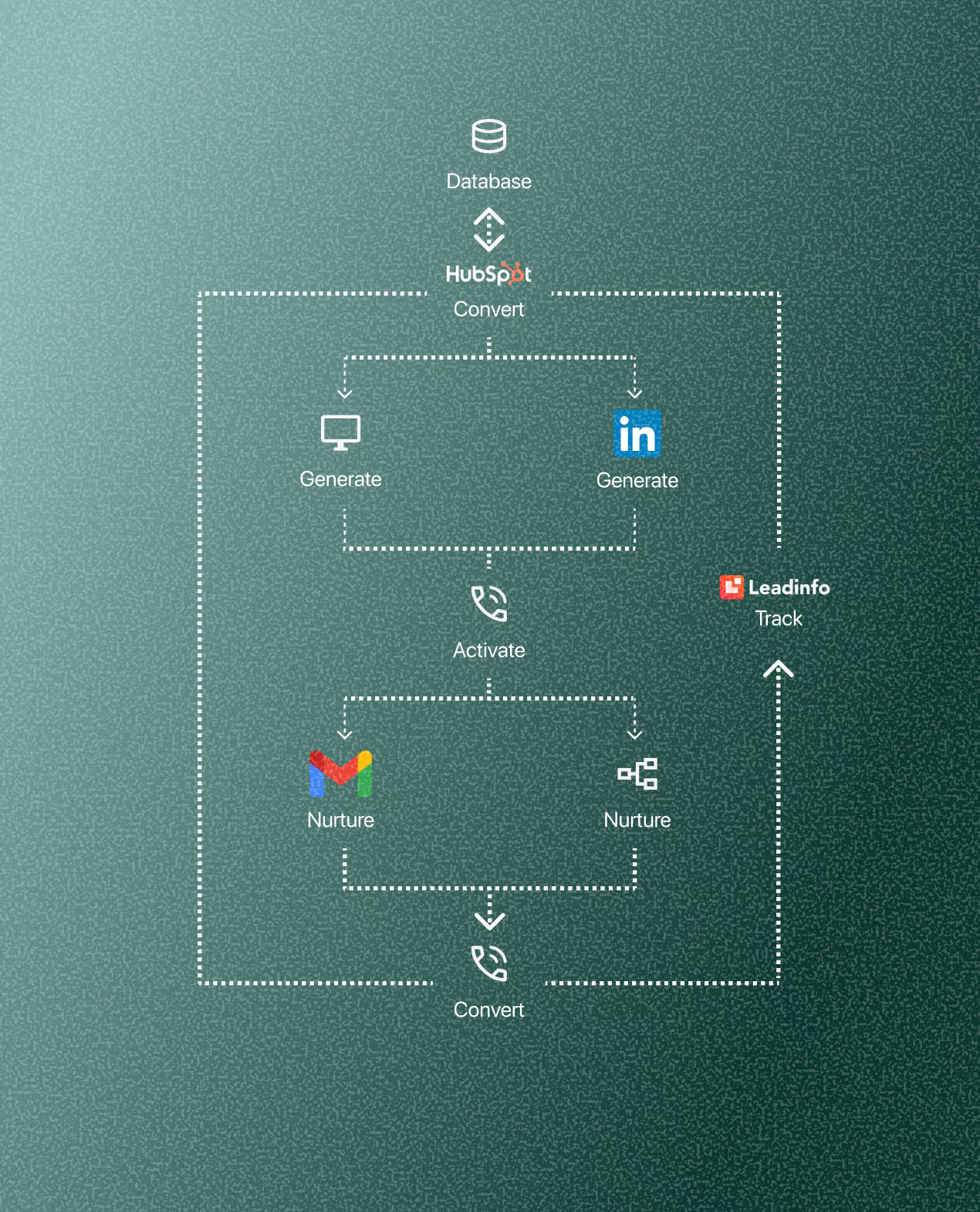
Tools like Leadinfo and Dealfront let you identify which companies visit your site, while HubSpot integrates these insights into your CRM. Here, you can directly attribute paid ads campaigns such as LinkedIn Ads to accounts in your CRM, finally closing the gap between marketing spend and closed deals.
Step 7 - From Data to Predictable Growth
When you combine outbound metrics, pitch analysis, structured pipelines, and marketing attribution, you create a revenue-intelligence loop. Now you have a system to track, steer and improve on.
The result:
- Clearer forecasting
- Faster deal cycles
- Higher ROI per rep
- Smarter marketing investments
That’s what predictable growth looks like.
Key Revenue Intelligence Takeaways
- Revenue intelligence spans B2B sales, B2B marketing and your entire GTM motion.
- Validate your Growth Multiple before scaling outbound.
- Measure operative efficiency - hours per SQL - to identify bottlenecks.
- Track pain points, VPs/USPs and objections to sharpen both sales and marketing.
- Ensure positioning consistency to build likability and trust.
- Integrate account-level attribution to understand full-funnel impact.
- Benchmark against 15–30% win rates and maintain 3:1 pipeline coverage for predictability.
Ready to Build Your Revenue Intelligence Framework?
If you’re leading a Professional Services or IT company in the Nordics and want to transform your sales data into predictable revenue, VAEKST can help.
We enable teams to define the right metrics, integrate the right tools, and build a scalable revenue model.
Let's have a chat about your GTM
Have a virtual cup of coffee with one of our sales experts to explore collaboration opportunities.